


Antwerp's most famous Statues and Monuments
Discover the hidden stories behind Antwerp’s most captivating statues—one sculpture at a time. This blog is your charming guide to the city’s artistic soul, where stone and bronze figures come to life with history, personality, and local flavour. Whether you’re a curious traveller or a hometown explorer, let these statues reveal a side of Antwerp you’ve never seen before.
” Art is the only realm where we can capture fleeting beauty and make it eternal.” – Peter Paul Rubens


1. The statue of Antony van Dyck
© Photography Antranik Manukyan
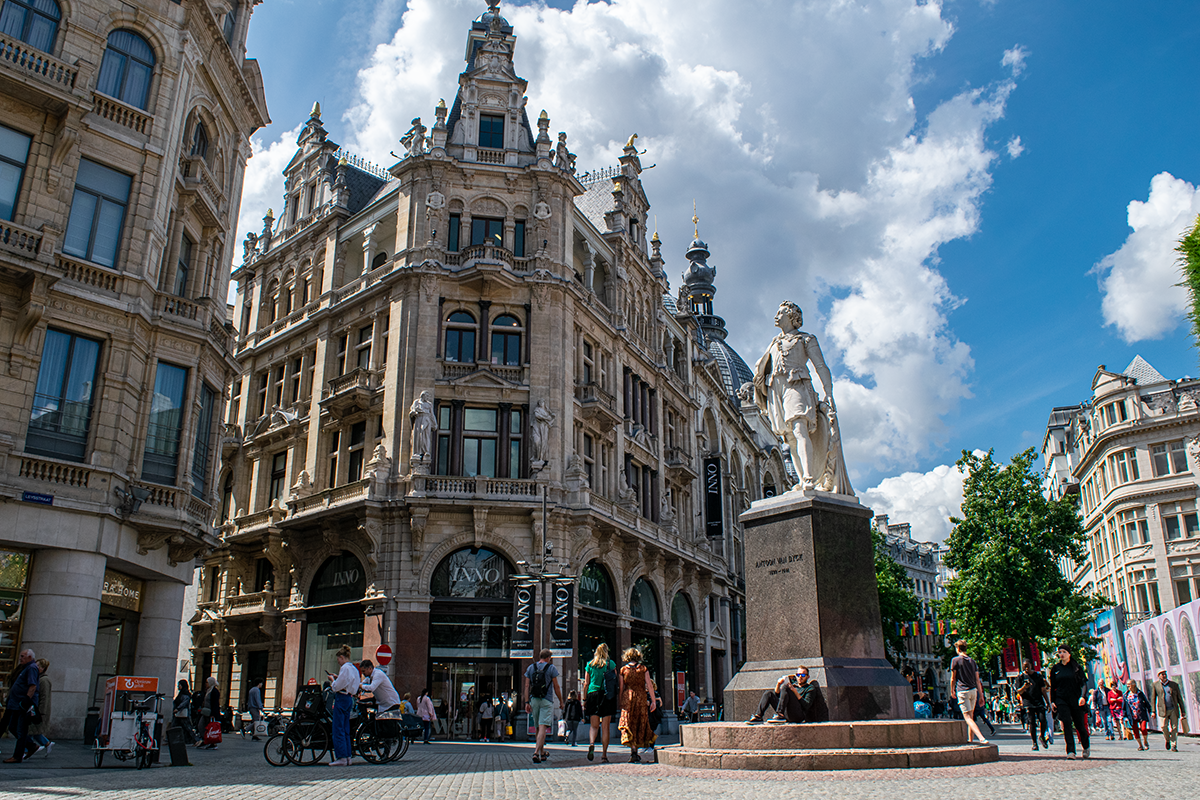
Nestled along the elegant Meir, Antwerp’s famed shopping boulevard, the white marble statue of Anthony van Dyck stands in quiet admiration of his birthplace. Poised with graceful confidence, the artist gazes toward the heart of the city that shaped his genius. Sculpted with reverence, the monument celebrates Van Dyck not only as a master painter, but as a symbol of Antwerp’s golden age of art and culture. Whether you’re a casual passerby or an art enthusiast, this charming statue offers a timeless tribute to one of Belgium’s most celebrated sons.
Did you know?
- Antony Van Dyck became an independent artist at just fifteen, displaying extraordinary talent from a young age.
- He was the most talented assistant of Peter Paul Rubens, who greatly influenced his early style.
- Van Dyck became the leading court painter to King Charles I of England, where he immortalized the nobility with elegance and flair.
2. The statue of David Teniers the Younger

© Photography Antranik Manukyan
Amid the lively rhythm of Meir Street, the statue of David Teniers the Younger quietly honours a master of everyday beauty. Depicted in period attire, with his right hand extended and holding what appear to be parchment documents in his left hand, and a thoughtful gaze, Teniers is immortalized in bronze, a tribute to his legacy as one of the greatest Flemish genre painters. The statue exudes charm and modesty, just like his art, which captured rustic taverns, village fairs, and scenes of daily life with warmth, wit, and a touch of mischief. It’s a delightful encounter for any passerby, connecting Antwerp’s rich artistic past with the city’s vibrant present.
Did you know?
- Teniers is a renowned 17th-century Flemish painter known for his genre scenes and landscapes, painting peasants, festivals, and markets with remarkable detail and humour.
- He was appointed court painter and curator of Archduke Leopold Wilhelm’s vast art collection in Brussels, essentially one of Europe’s first art curators!
- Teniers had a fascination with alchemy and frequently depicted alchemists in his works, blending science, mystery and artistry.
3. The statue of Peter Paul Rubens
© Photography Antranik Manukyan
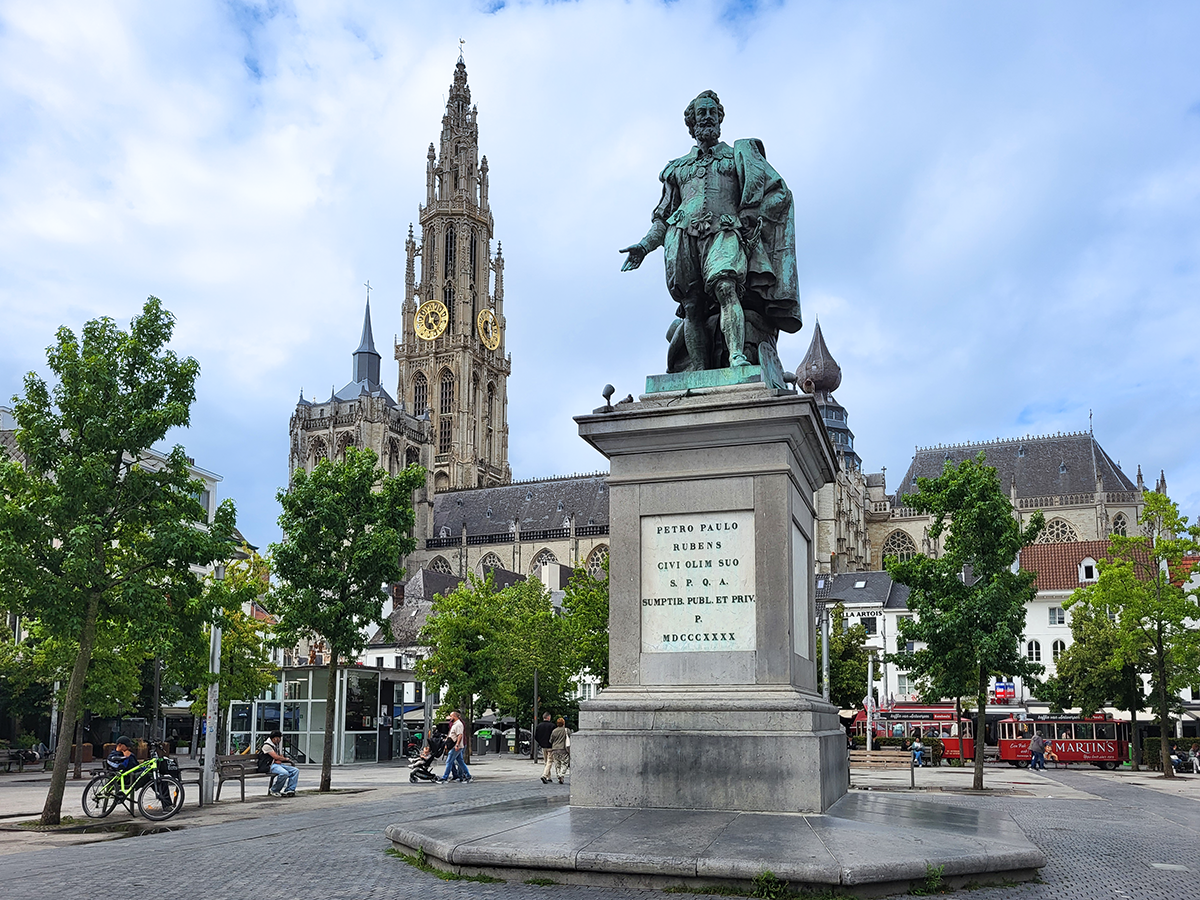
In the very heart of Antwerp’s old city, beneath the towering spire of the Cathedral of Our Lady, Peter Paul Rubens stands immortalized in bronze on the lively Groenplaats. With a painter’s cloak draped elegantly over his shoulders and a confident gaze surveying the square, this statue is more than just a monument, it is a proud tribute to Antwerp’s greatest artistic son. Unveiled in 1843 and created by sculptor Willem Geefs, the statue captures Rubens as both a worldly gentleman and a creative giant. With a hand gesturing as if in mid-conversation, fitting for a man who moved effortlessly through courts, studios, and salons, leaving a legacy of colour, drama, and grandeur behind him.
Did you know?
- Born in Siegen, Germany, but raised in Antwerp, Rubens became the leading Baroque painter of Northern Europe. His vivid, dynamic paintings burst with energy, emotion, and classical beauty.
- He wasn’t just a painter, Rubens was also a diplomat, scholar, architect, and polyglot. He negotiated treaties between warring nations and mingled with royalty across Europe, all while producing hundreds of masterworks.
- His house and studio, now the Rubenshuis Museum, is one of Antwerp’s most visited sites and offers a glimpse into the world of 17th-century art, with original works by Rubens and his contemporaries.
4. The statue of Hendrik Conscience
© Photography Antranik Manukyan
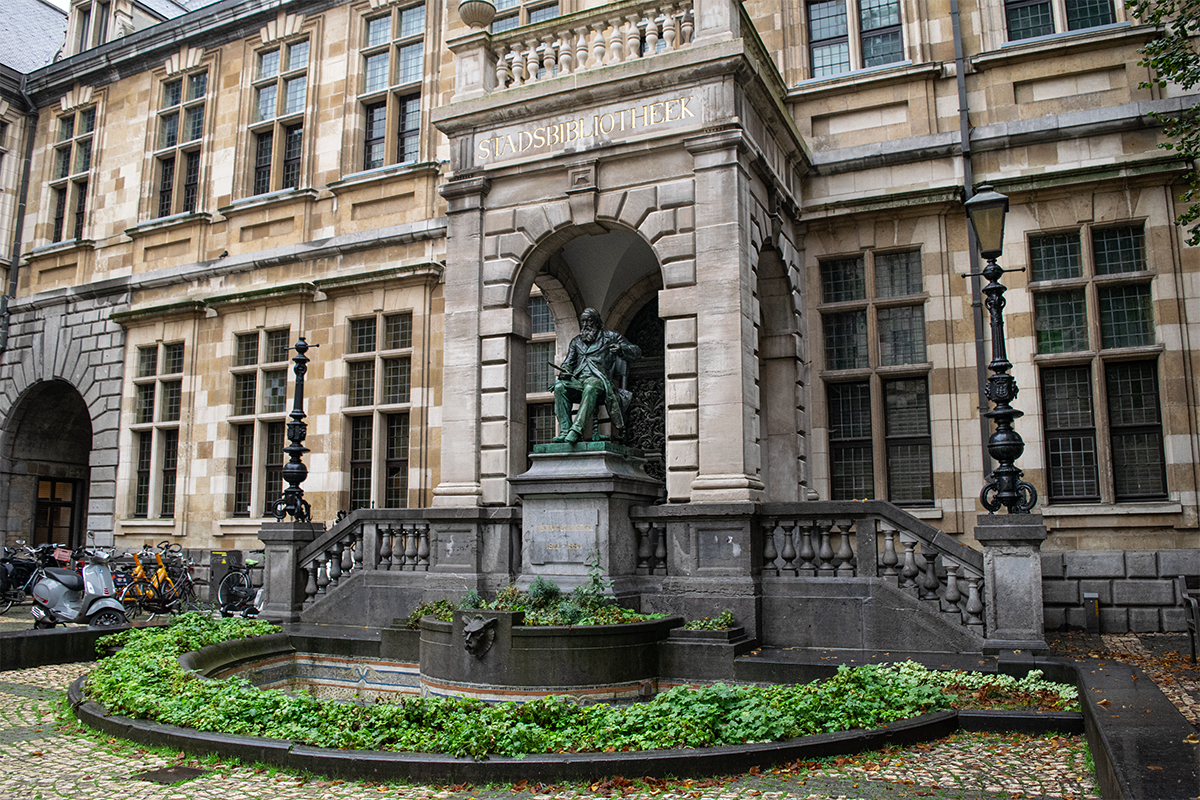
Situated beneath the gracious portico of the Hendrik Conscience Heritage Library, this statue is a beautiful blend of history and homage, an elegant welcome at the gateway to Antwerp’s literary heart. Crafted by the Belgian artist Frans Joris and unveiled in 1883, it portrays Conscience seated with gentle dignity, as if pausing between moments of inspiration, reflecting both his literary depth and approachable spirit. Nested near the Baroque elegance of St. Charles Borromeo Church, it offers a serene yet stirring homage to the man “who taught his people to read.”
Did you know?
- Born in Antwerp in 1812 to a French father and Flemish mother, Conscience chose to write in Dutch, even when French ruled the high society. This earned him the title “Who taught his people to read”.
- He joined the Belgian Revolution in 1830, served in the army until 1836 and then he returned to Antwerp to launch his literary career.
- His 1838 novel De Leeuw van Vlaanderen (The Lion of Flanders), inspired by Flemish bravery at the 1302 Battle of the Golden Spurs, remains a cornerstone of Flemish cultural pride.
5. The sculpture of Nello & Patrasche
© Photography Antranik Manukyan
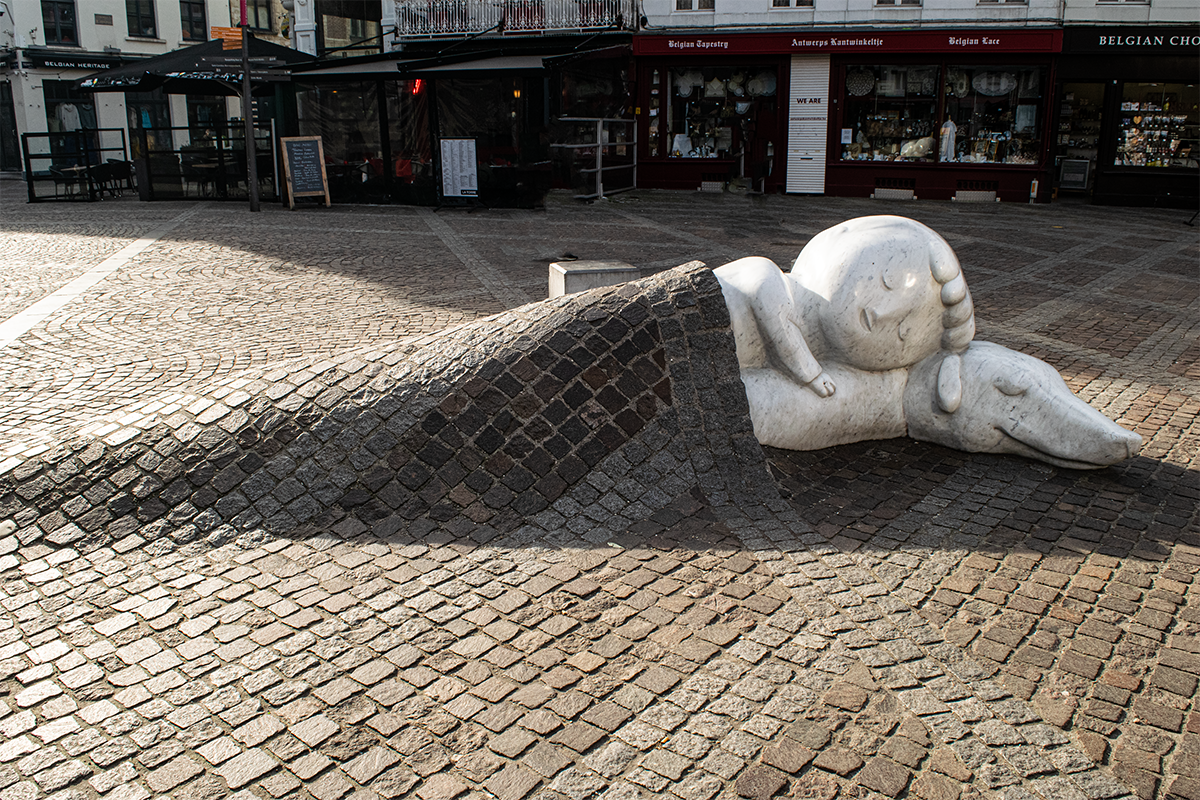
In the quiet shadow of Antwerp’s majestic Cathedral of Our Lady lies one of the city’s most heartwarming tributes, the statue of Nello & Patrasche. Just beneath a cobblestone blanket, the boy and his loyal dog rest peacefully together, forever united in stone. Designed by artist Batist Vermeulen in 2016, this touching sculpture invites passersby to pause and reflect on love, loyalty, and the bittersweet power of story. Though fictional, Nello and Patrasche have become beloved figures in Antwerp, their statue a poignant contrast to the grandeur around them and a gentle reminder of kindness in an often-harsh world.
Did you know?
- A Dog of Flanders was written in 1872 by the English author Marie Louise de la Ramée, but set in Antwerp, a city she never actually visited.
- An Orphan and a Rescue, Nello, a poor orphan boy, saves an abandoned cart dog, Patrasche. Together, they share a deep bond as they face life’s hardships with quiet strength.
- Nello dreams of becoming a painter and yearns to see Rubens’ altarpiece inside the Cathedral, which he cannot afford to access, until the final, tragic night.
- Cold and destitute, Nello and Patrasche die together inside the cathedral before the masterpiece, in one of literature’s most touching finales.
6. The Hand Statue of Druon Antigoon

© Photography Antranik Manukyan
Strolling down Antwerp’s fancy Meir street, you’ll encounter a giant, weathered hand casually lying on the cobblestones, no base, no sign, just a palm catching eyes and imaginations. Created by French sculptor Henri de Miller and placed here in 1992, this whimsical yet powerful installation is a tactile nod to Antwerp’s founding legend. Children climb on it, tourists pose beside it, and locals smile at its subtle reminder of how myth shapes a city’s identity. It’s art that invites touch and tells a story, one hand at a time.
Did you know?
- The hand belongs to Druon Antigoon, a giant who once terrorized river travellers by cutting off their hands if they refused to pay his toll on the Scheldt.
- A young Roman soldier named Silvius Brabo bravely slew the giant, sliced off his own hand, and flung it into the river. The heroic act said to explain Antwerp’s name, hand werpen, meaning “to throw a hand”.
- The giant hand stems from de Miller’s 1986 Paris sculpture L’Écoute, “The Listener”. Antwerp purchased just the hand in 1991, without the head or intended circular base. It was installed directly on the street in 1992.
7. The statue of Baron Henry Leys
© Photography Antranik Manukyan
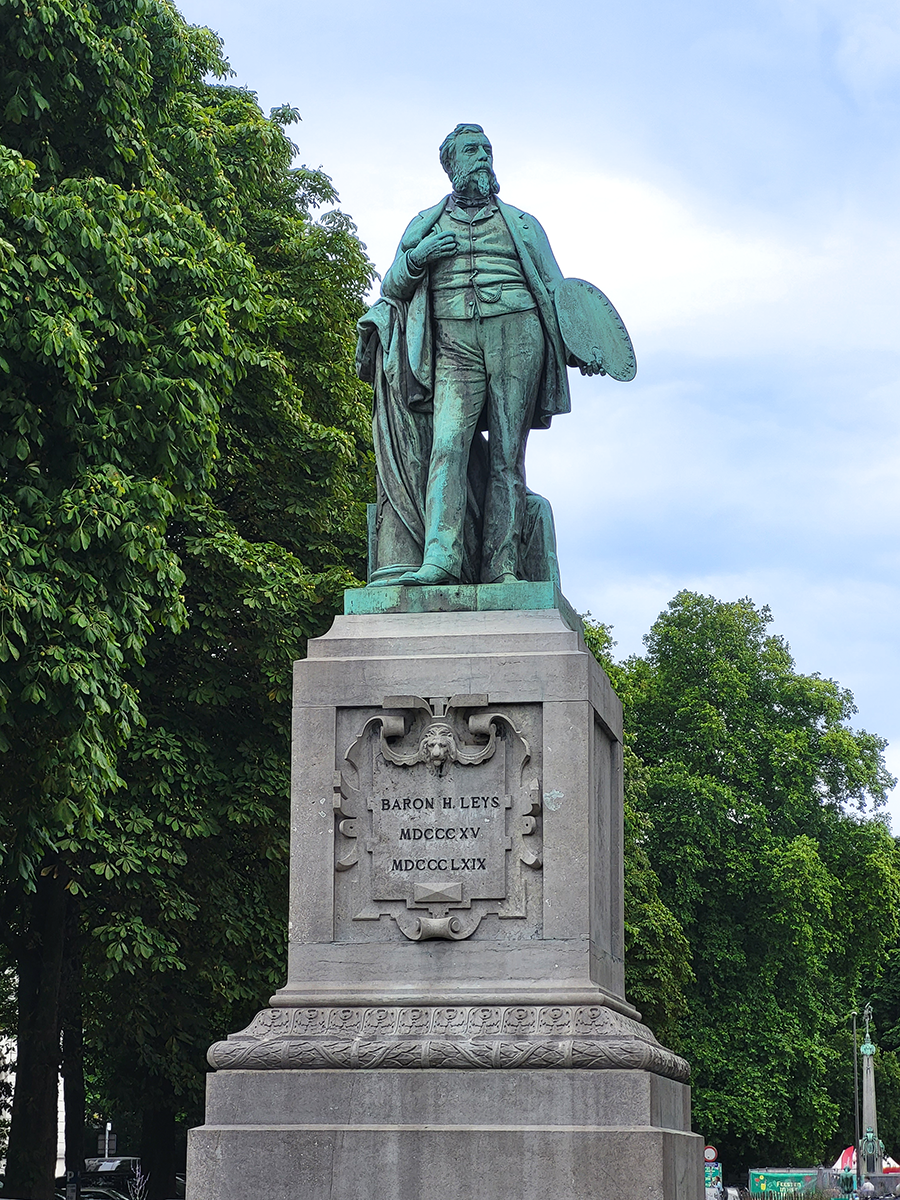
Standing gracefully on the central boulevard Frankrijklei leading into Stadspark, the bronze statue of Baron Henri Leys captures the elegance and intellect of this celebrated 19th-century Antwerp painter. Sculpted by Joseph-Jacques Ducaju and unveiled by King Leopold II in 1873, the statue portrays Leys in dignified contemporary attire, palette in hand, leaning thoughtfully on a column draped with his painter’s cloak and canvas, an artistic homage set in serene greenery.
Did you know?
- Born in Antwerp in 1815, Leys rose to fame for historical and genre paintings, carefully reconstructing 16th-century Antwerp scenes with remarkable authenticity.
- Early influenced by Romantic painter Gustave Wappers, Leys later embraced a realist style inspired by 15th–16th-century masters like Dürer and Holbein, winning medals in Paris and London.
- Ennobled by King Leopold I in 1862, he also served on Antwerp’s city council and received international honours.
His historical painting “The Thirty Days Mass for Berthal de Haze” (1854) was awarded gold medal at the 1855 World’s Fair in Paris. He also received international recognition at London’s World Fair in 1862.
8. The statue of Brabo

© Photography Antranik Manukyan
At the heart of Antwerp’s bustling Grote Markt stands the majestic Brabo Fountain, where the legendary hero Silvius Brabo is caught mid-throw, brandishing the severed hand of the defeated giant Druon Antigoon. Sculpted by Jef Lambeaux and unveiled in 1887, this powerful bronze tableau bursts with drama. The Brabo is heroically poised atop a rocky base, surrounded by mermaids, sea creatures, and the fallen giant, all beneath the watchful facades of guildhalls and the grand City Hall. Brabo’s dynamic stance aligns as if he’s flinging the giant’s hand toward the city itself, symbolizing Antwerp’s triumph and freedom.
Did you know?
- According to medieval folklore, giant Druon Antigoon terrorized Scheldt River traffic by demanding tolls and chopping off defaulters’ hands. Brabo, a Roman soldier, bravely defeated him, severed his own hand, and tossed it back into the river, giving Antwerp its name (Hand Werpen: “throwing hand”) .
- The fountain’s creation in 1887 coincided with renewed pride in the city’s sovereignty after centuries of tolls on the Scheldt, the gesture of throwing the giant’s hand became a metaphor for reclaiming free commerce.
- Beyond Brabo and Antigoon’s head at the base, the fountain is adorned with mythic mermaids supporting a castle emblematic of Antwerp, and bronze water animals, turtles, sea lions, dragons, blending local lore with ornate design.
9. The Monument of Schelde Vrij
© Photography Antranik Manukyan
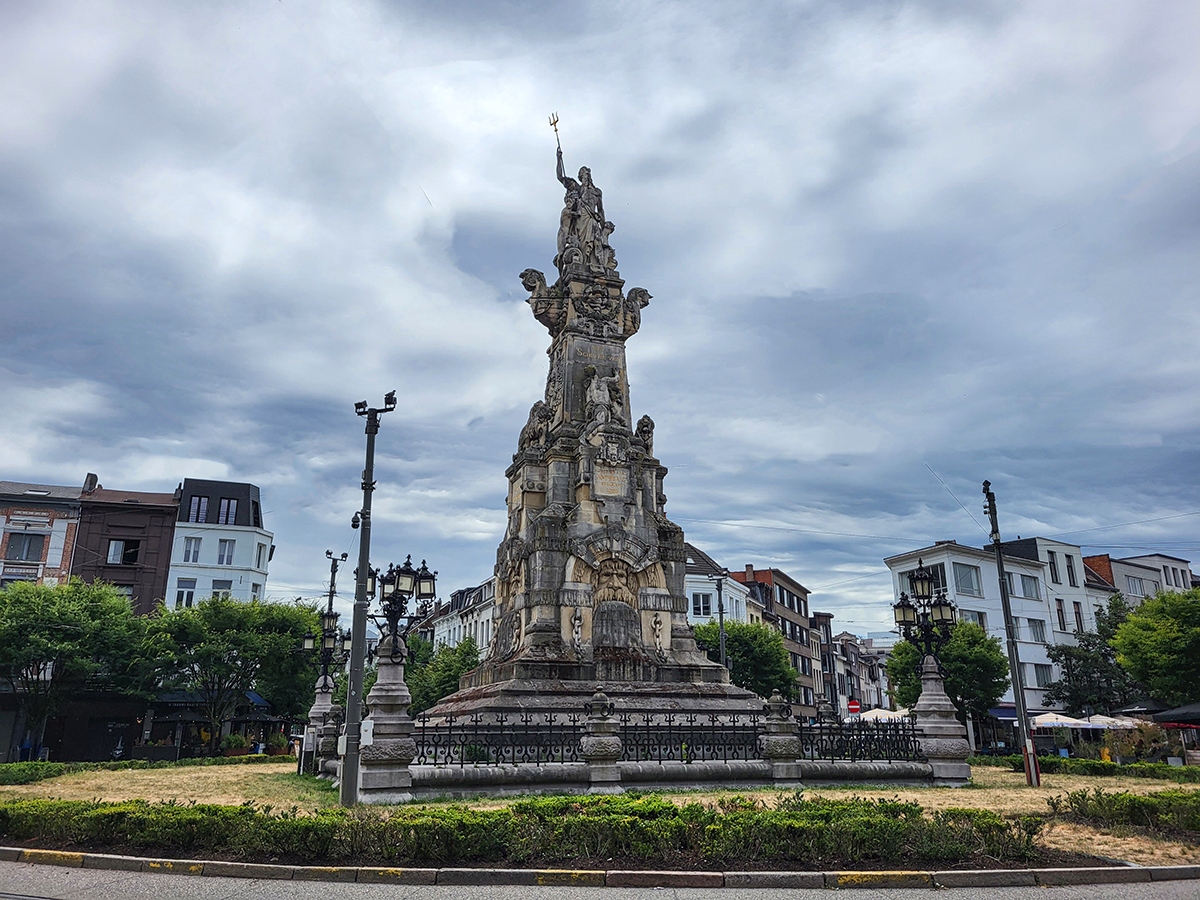
Rising proudly in the circular embrace of Marnixplaats, where avenues of ‘Zuid’ radiate east and west, stands the towering “Schelde Vrij” monument. It is revealed in 1883 and crafted in flamboyant neo‑Vlaamse renaissance style by architect Jean‑Jacques Winders. It is twenty metre high obelisk with lions standing at its base with a broken chain under the watchful masks of water‑gods, celebrating the liberated river. Midway, a kneeling allegorical Antwerp woman chisels the monument into stone. Topping the monument is the dramatic grouping of Neptune, Mercury, and the city maiden, crowned by sea‑symbols and ship prows. Encircled by ornate iron lampposts and railings, it’s both a civic beacon and a sculptural spectacle.
Did you know?
- After nearly 250 years under Dutch tolls since 1587, Antwerp celebrated the end of Scheldt restrictions. The Belgian government redeemed the toll in May 1863, a move seen as crucial for reopening maritime trade.
- The city held a 1873 competition won by Winders. Despite plans for a 1874 unveiling, technical setbacks delayed its completion until 1883.
- Neptune wields his trident, Mercury represents trade, the city maiden symbolizes Antwerp’s rebirth.
10. The Statue of Peeter van Coudenberghe
© Photography Antranik Manukyan
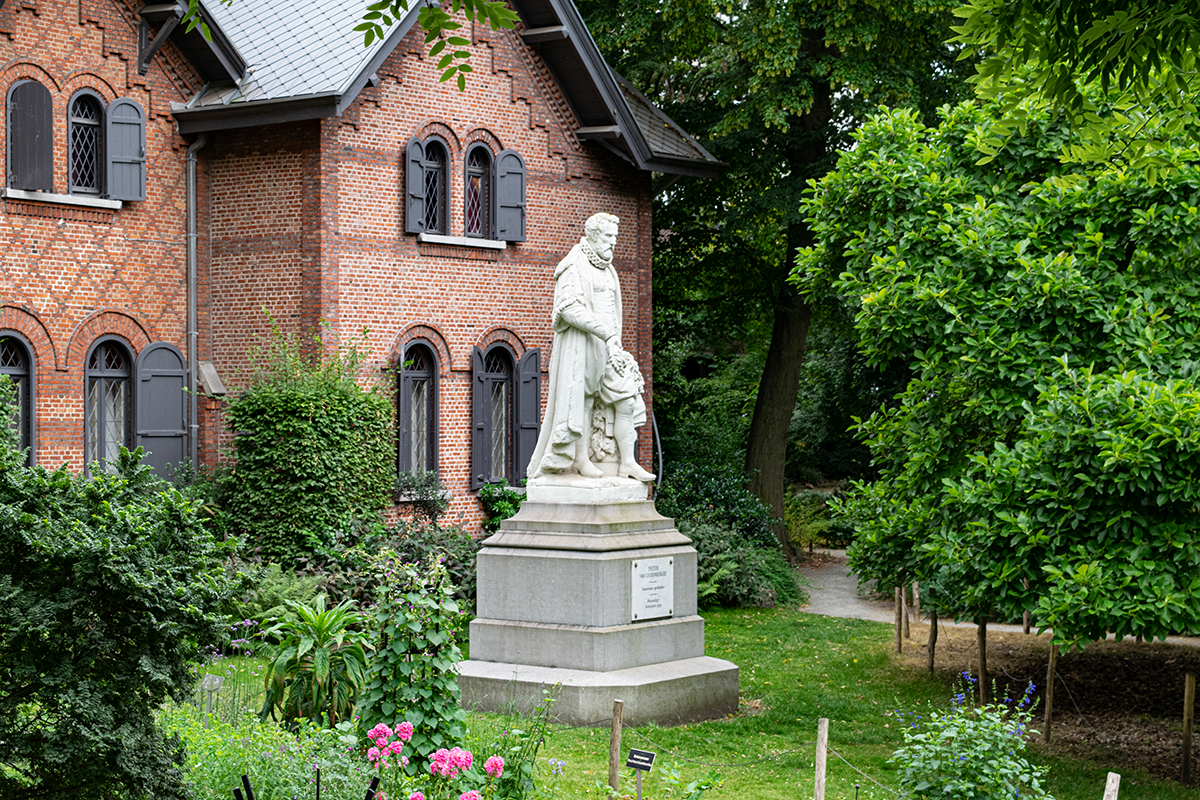
Tucked gently among the greenery of Antwerp’s Botanical Garden, the statue of Peeter van Coudenberghe stands as a quiet guardian of the city’s herbal past. In 1861, on the initiative of Antwerp’s pharmacists, sculptor Pierre‑Joseph de Cuyper (1808–1883) created a marble statue of Coudenberghe. It was initially installed in the City Park (Stadspark), but In 1869, the statue was relocated to Den Botaniek (Botanical Garden) on Leopoldstraat, serving as a memorial of the city’s botanical predecessor and honouring its first known botanist. Today, this statue stands in front of the distinctive Swiss‑chalet–style lodge that serves as the garden’s entrance, surrounded by historic brick buildings, magnolia trees, and well‑kept lawns, the perfect frame for a silence‑guarding monument.
Did you know?
- Professionally, he was a pharmacist and botanist, considered one of Antwerp’s earliest botanical pioneers. Around 1571, he cultivated a renowned herb garden just outside Antwerp’s city walls, hosting around 600 plant species, including exotic plants acquired through the city’s global trade links.
- Coudenberghe translated and annotated Valerius Cordus’s Dispensatorium pharmacorum, published in Antwerp in 1568, with later editions in 1580 and 1599, this work is regarded as the first pharmaceutical publication in Antwerp.
- His garden was destroyed during the Siege of Antwerp (1584–85) by the Spanish army, and he lost a son in the conflict; any plans to publish a catalogue of his garden were likely lost.
11. The Monument of Peter the Great
© Photography Antranik Manukyan
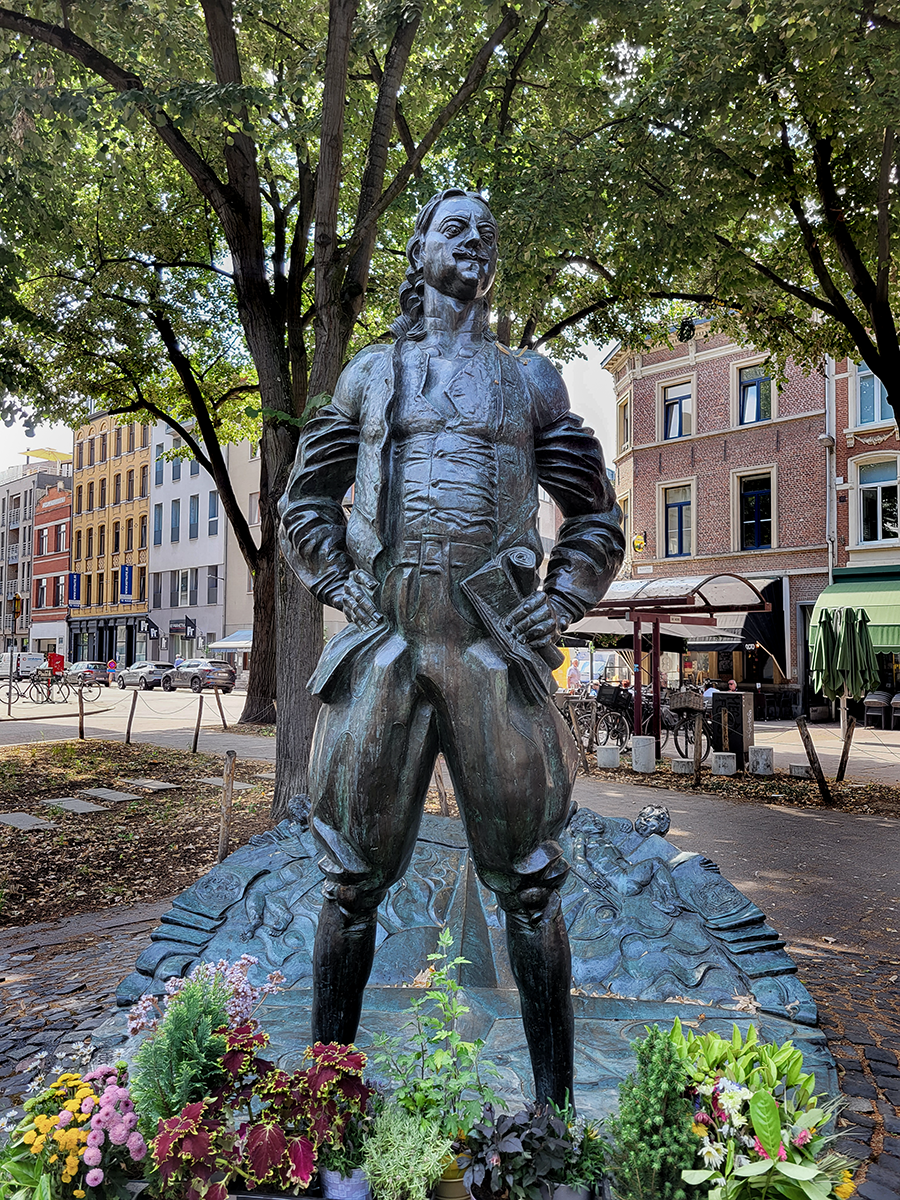
In the artsy, antique-filled stretch of Kloosterstraat in Antwerp, among vintage boutiques and tucked façades, stands an eye-catching bronze figure: Peter the Great, Russia’s visionary Tsar, captured mid-stride as if still exploring the streets himself. Standing with confident posture and a sense of restless energy, this monument commemorates the Russian ruler’s remarkable visit to Antwerp in 1717, during his famed European Grand Tour. Unveiled in 1998 and sculpted by Georgy Frangulyan, the statue shows Peter not as an imperial figure seated on a throne, but as a tall, dynamic man of action, thoughtful, curious, and ever in motion.
Did you know?
- Peter I, known as Peter the Great, ruled Russia from 1682 to 1725 and is celebrated for his sweeping reforms that modernized Russia, bringing it closer to the cultural, military, and scientific developments of Western Europe.
- The Grand Embassy of Peter the Great (1697–1698) was a historic diplomatic mission across Europe undertaken by Tsar Peter I of Russia. Traveling incognito as “Peter Mikhailov,” he visited England, the Netherlands, Austria, and Prussia to seek allies against the Ottoman Empire and to study Western technology, culture, and military organization.
- In 1717, Peter visited Antwerp for several days, studying its port infrastructure, shipyards, and trade networks.
12. The Vase with Bas Relief by Johann Friedrich Drake
© Photography Antranik Manukyan
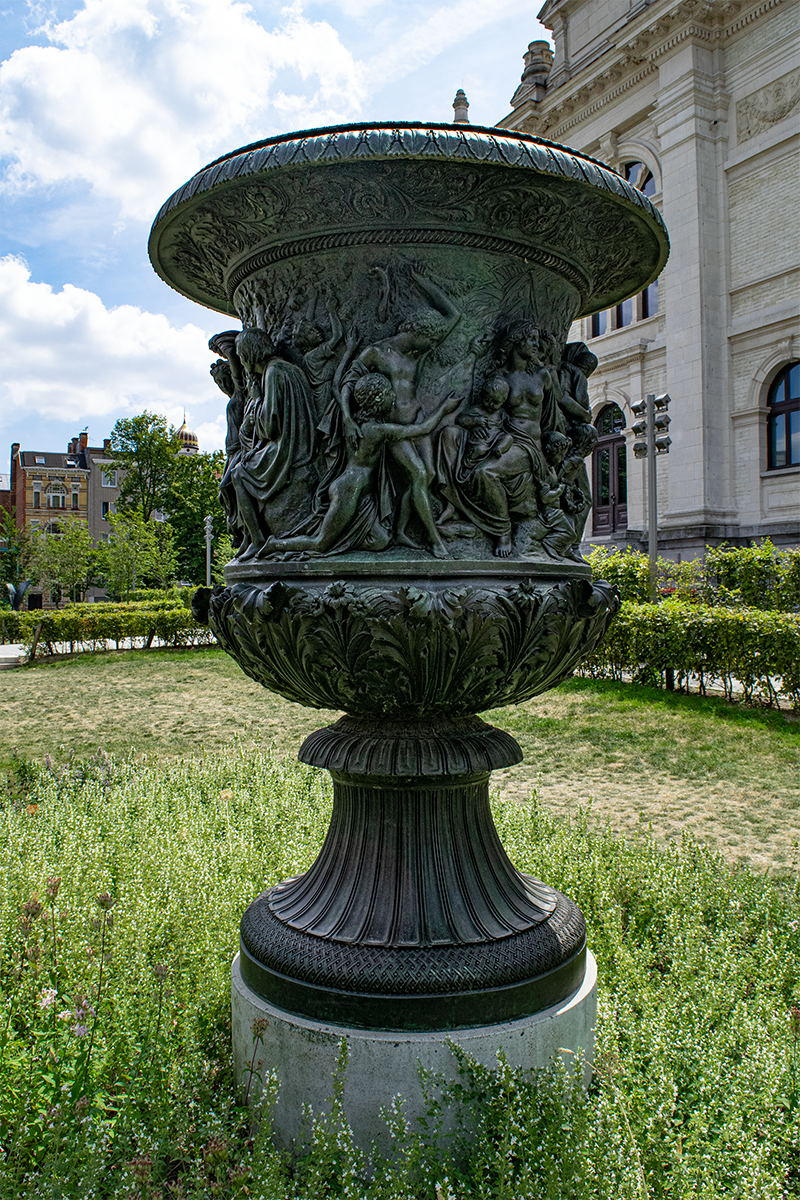
Nested beside the grand Royal Museum of Fine Arts Antwerp (KMSKA), the elegant sculpture known as “Vase with Bas Relief” by Johann Friedrich Drake feels like a poetic pause between the world of nature and the world of art. Often overlooked by hurried museumgoers, this ornate bronze vase stands gracefully in the garden, crowned with mythological figures and classical scenes in soft relief, a tribute to beauty, craftsmanship, and timeless storytelling. Created by German sculptor Johann Friedrich Drake, this neoclassical masterpiece blends functionality with artistry. Though called a “vase,” it is far more sculptural than utilitarian, adorned with allegorical figures, musical motifs, and gently flowing garlands that reflect 19th-century Romanticism’s love for antiquity. It invites quiet contemplation, much like a silent witness to the evolving tastes of art through the centuries.
Did you know?
- Johann Friedrich Drake was a celebrated 19th-century sculptor from Germany, best known for large-scale public works such as the Victory Column (Siegessäule) in Berlin. Yet, he also created more intimate pieces like this vase, which show his attention to form, detail, and symbolism.
- The “Vase with Bas Relief” was placed in the museum garden in the early 20th century, when garden sculpture was seen as an extension of the museum experience, creating an open-air gallery where art and nature could converse.
- The reliefs on the vase often depict mythological or musical themes, possibly alluding to the Muses or the harmony between the arts, a fitting tribute to its setting beside one of Belgium’s most treasured art collections.
13. A Little Man with a Big Heart
© Photography Antranik Manukyan
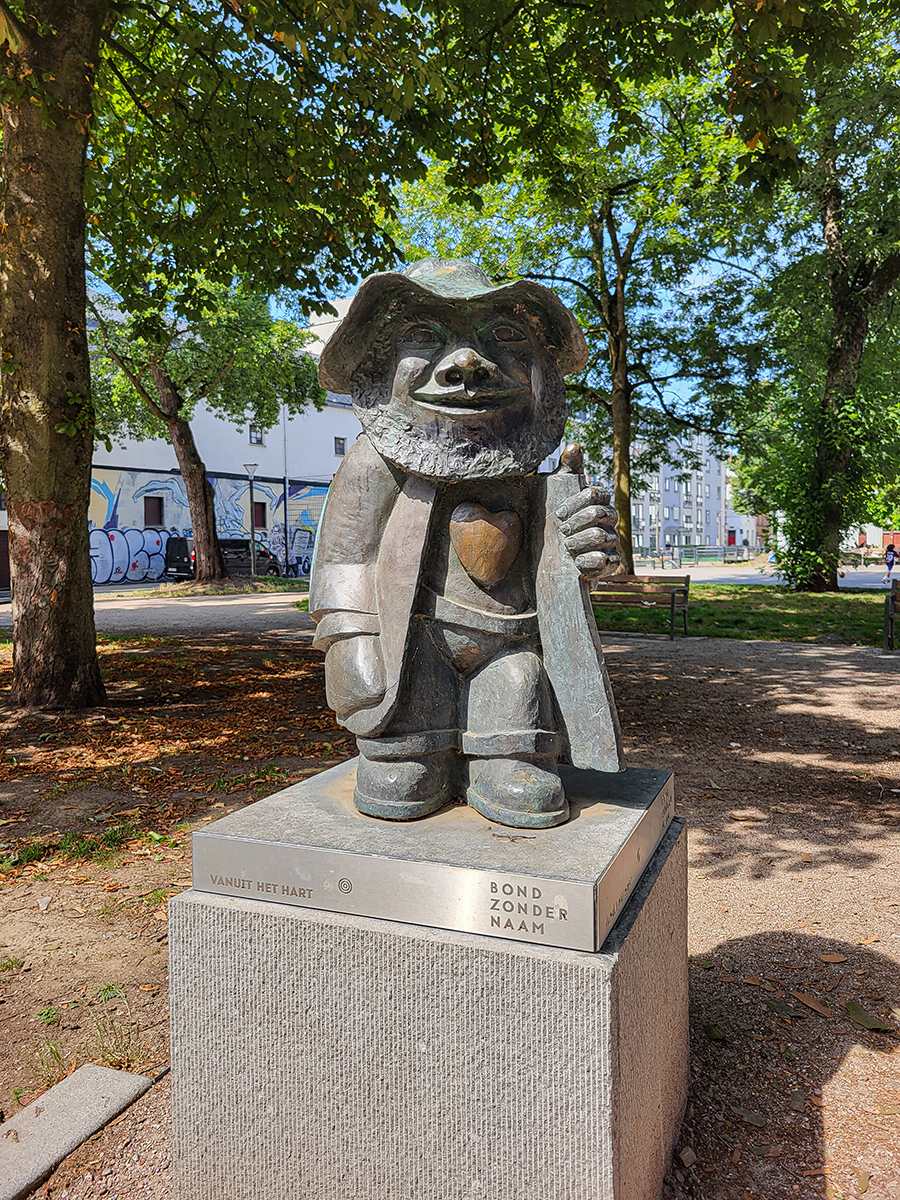
You can find this remarkable little statue on the corner of Frans Halsplein near the Sint‑Jacobsmarkt. It is known as “Oasemanneke”, an endearing bronze sculpture of a short, bearded man in a broad overcoat and hat. With a playful yet warm gesture, he opens the left side of his coat to reveal a large heart, an invitation to kindness, compassion, and openness in the bustling streets of Antwerp. It was created in 1993 by the Belgian sculptor Marjet Dooremont, commissioned by Bond Zonder Naam, a Belgian social movement founded by Phil Bosmans, to promote tolerance, friendship, and a welcoming spirit in the city
Did you know?
- Originally erected near the Bond Zonder Naam headquarters, it stands as a living metaphor for their slogan: “Er zit een hart onder mijn jas” (“There’s a heart under my coat”), a phrase once inscribed on its pedestal in reference to a popular book by Bosmans.
- The figure’s modest size, whimsical hat, and kind smile surprise passersby, and delight children and adults alike with its down-to-earth warmth.
- Marjet Dooremont (1922–2010) was a celebrated Flemish artist trained in painting, sculpture, and graphic arts. She created Oasemanneke as a tribute to the values of Bond Zonder Naam and Father Phil Bosmans, supporting social solidarity, respect, and human dignity in everyday life.
14. The statue of Jacob Jordaens
© Photography Antranik Manukyan
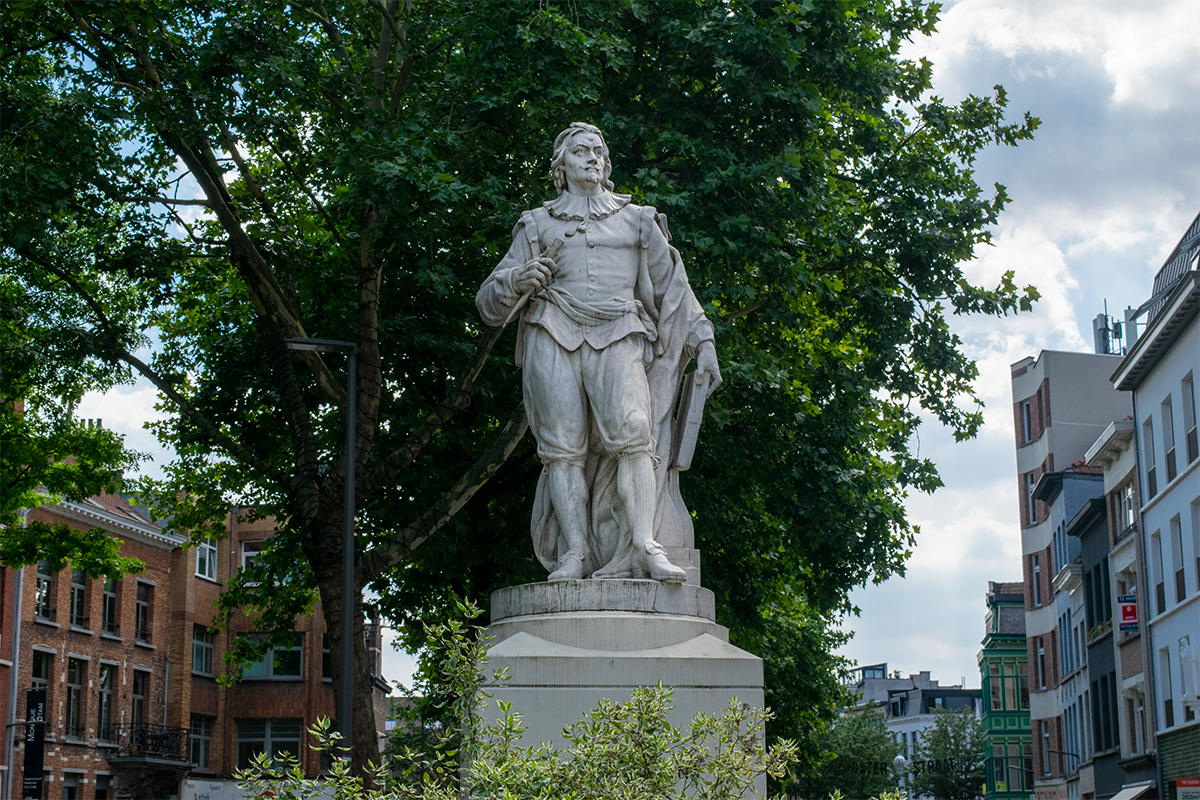
Peacefully located on Oever Street, near the exit of the Sint-Jansvliet pedestrian tunnel, stands a dignified marble statue of Jacob Jordaens (1593–1678). Here, Antwerp pays homage to one of its greatest Flemish Baroque painters, a robust, reflective figure carved in 1880, looking onward much as the artist’s creative vision looked beyond his time. Created by the German sculptor Jules Pécher, the statue shows Jordaens in 17th-century garb, standing over 3 meters tall in white marble, his gaze steady and serious. The pedestal bears the inscription “Jacob Jordaens kunstschilder 1593 – 1678”, affirming both his craft and his lasting connection to Antwerp.
Did you know?
- First erected in 1880 on Van Breestraat, moved in 1901 to Gemeentestraat, and finally placed on Oever Street in 1986, the sculpture has witnessed Antwerp’s shifting urban landscape.
- Born and trained in Antwerp, Jordaens remained rooted in the city for his entire life, unlike Rubens and van Dyck, he never travelled to Italy, yet still rose to lead the Baroque movement in the region.
- Following the deaths of Rubens (1640) and van Dyck (1641), Jordaens emerged as the preeminent Flemish painter, known for genre scenes like “The King Drinks” and “As the Old Sing, So Pipe the Young”, full of energy, humour and moral observation.
15. The Ghost Statues in Den Botaniek
© Photography Antranik Manukyan
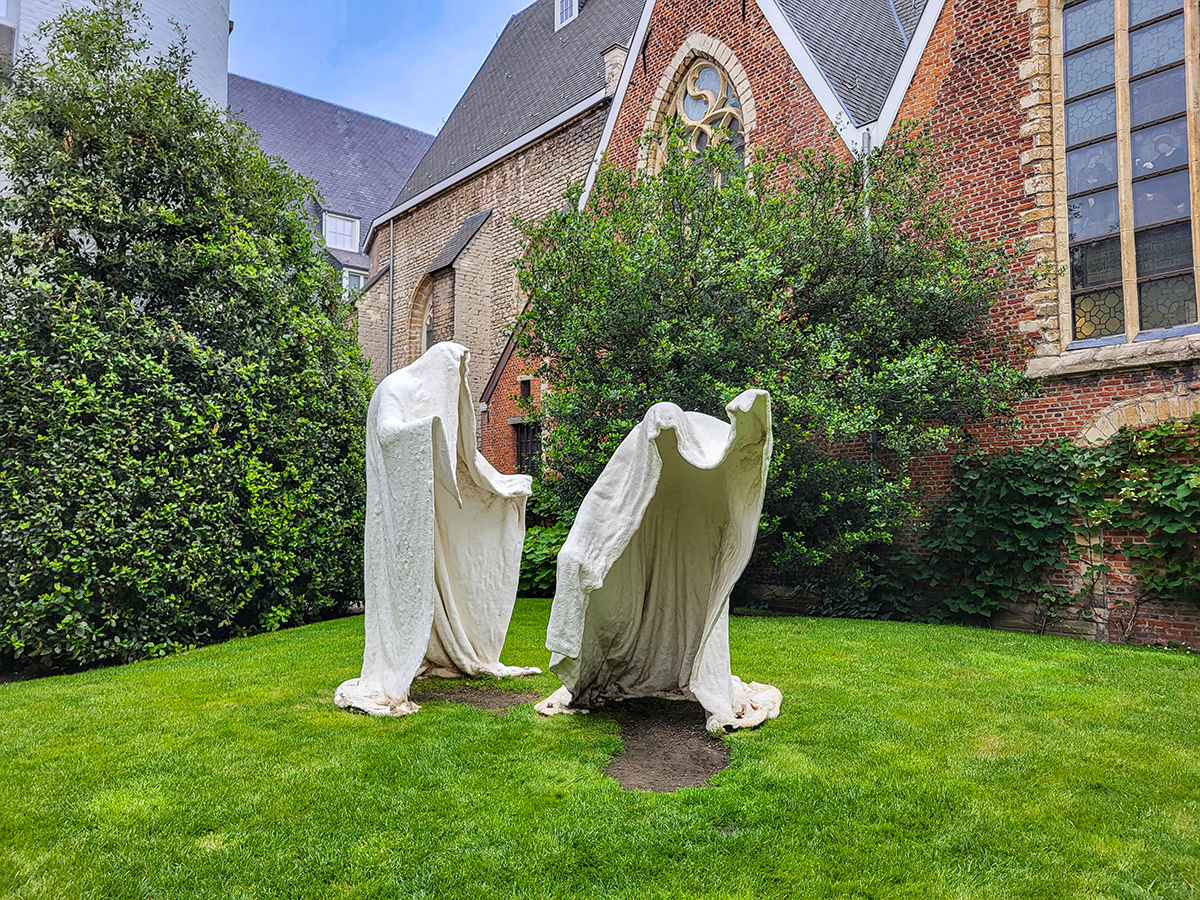
Wandering through the tranquil paths of Den Botaniek in Antwerp, you may encounter two ethereal sculptures—ghost statues by the Polish‑Belgian artist Albert Szukalski, standing quietly among the greenery, as if caught between earth and memory. Szukalski’s figures appear draped in flowing white robes, their forms suggestive but without detail, hollow silhouettes shaped by real people and frozen in motion, evoking a dreamlike presence in the botanical calm.
Did you know?
- Though the garden hosts over 2,000 plant species, these two ghostly figures feel like gentle echoes of past lives—spectres amidst leaves, inviting reflection and a momentary hush in the leafy landscape.
- Albert Szukalski (1945–2000) perfected his ghost-making by draping plaster-soaked fabric over live models. Once dry, the models left, and Szukalski reinforced them with polyester. The result, solid yet spectral sculptures that blur the line between presence and absence.
- Szukalski is best known for his dramatic “Last Supper” ghost ensemble in Nevada’s desert, but these two in Antwerp are intimate echoes of his larger works, relocated into a green sanctuary rather than a barren landscape.
16. The statue of Netje

© Photography Antranik Manukyan
Tucked into the green knot of the Sint-Andriesplein, just south of St. Andrew’s Church, stands a quiet yet evocative figure lovingly known as Netje. Sculpted in 1951 by Leopold Van Esbroeck, the statue presents a compassionate mother figure, gently gazing down, nurturing the memory of a city and its people. Clad in simple mid-century attire, Netje embodies both resilience and warmth, paying tribute to Antwerp’s working-class heritage. Here, literature and landscape meet, where this humble sculpture speaks volumes about empathy in public art.
Did you know?
- “Netje” is inspired by Antoinette, the maternal protagonist of Lode Zielens’ 1932 novel “Moeder, Waarom leven wij?”
- The statue was designed by Leopold Van Esbroeck in 1951. Originally placed at Plantin-Moretuslei in Simonsstraat, it was moved to its current spot in the churchyard behind St. Andrew’s in 1975.
- A bronze plaque at the base identifies the character and her author. Zielens tragically died in 1944 during a V-1 bomb attack on Antwerp, and Netje stands as a tribute to his vivid literary contribution and the suffering he witnessed.
17. The Buildrager Statue (Arbeid Vrijheid)
© Photography Antranik Manukyan
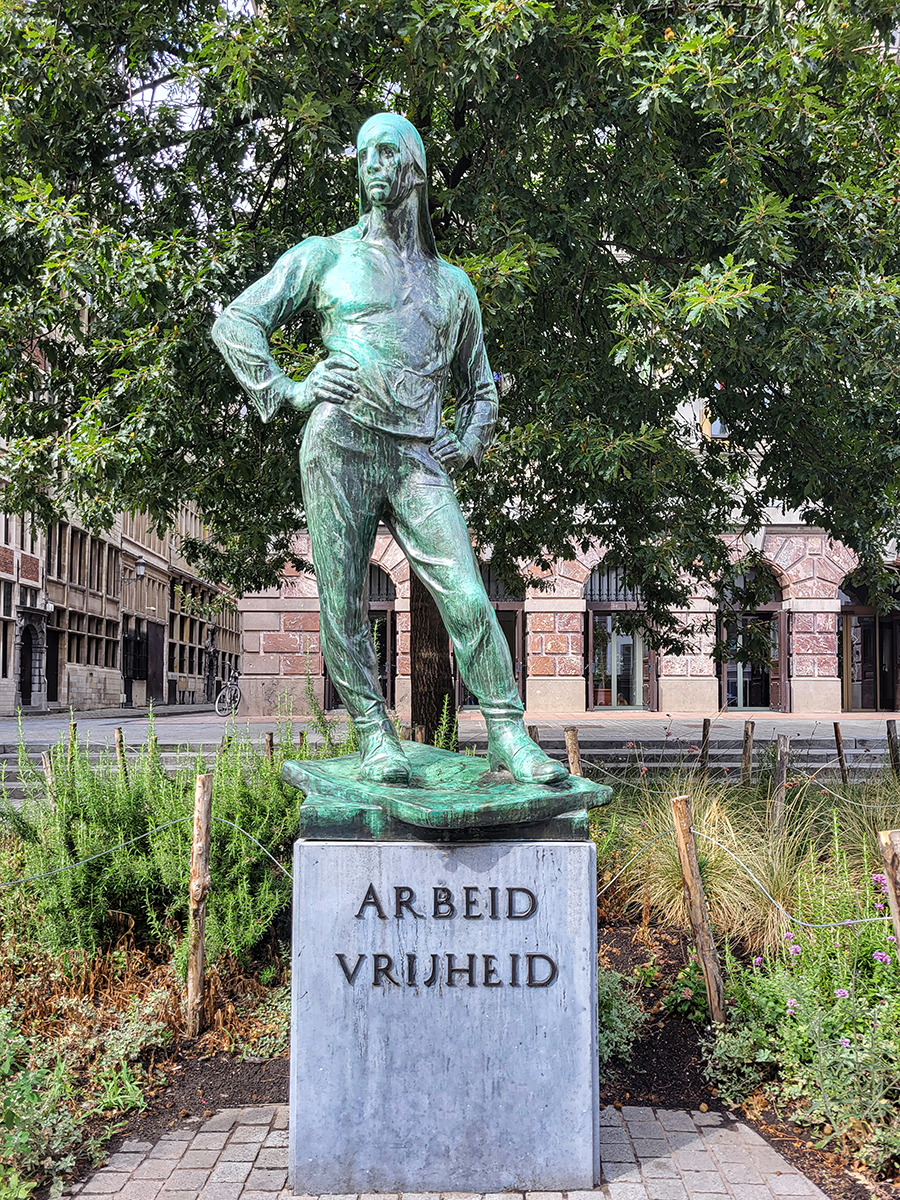
Situated beside Antwerp’s baroque City Hall on Suikerrui, stands the stirring bronze figure known as “De Buildrager”, with inscription “Arbeid Vrijheid” (Labour Freedom). Sculpted by Constantin Meunier and inaugurated on 4 September 1950, this piece captures the dignity, strength, and pride of the dockworkers who kept Antwerp’s port alive during its darkest hours. His pose is proud and steady, gaze fixed toward the Scheldt River and beyond. Etched into its pedestal are the words “Arbeid – Vrijheid”, a motto signifying the union of labour and liberation, famously embraced by the Belgian working-class movement.
Did you know?
- Created by Constantin Meunier, a Belgian artist celebrated for elevating the working man in sculpture. Known for a compassionate realism, his works like De Buildrager portray workers not with bowed heads, but as dignified, heroic figures, modern-day statues of virtue.
- The original statuette debuted in wax at the Salon des XX in 1885, followed by plaster and bronze editions. In 1890, France acquired a bronze copy, and full-size casts soon travelled to European cities like Frankfurt, Dresden, Copenhagen, even Lima and Stockholm.
- The sculpture is a symbolic memorial maintained by dockworkers’ and labour unions, with annual tributes on 1 November. The original 1893 version stands in the KMSKA museum garden, while the city statue is a 1950 replica by G. & J. Minne foundry in Ghent .
18. The Equestrian Statue of King Leopold I
© Photography Antranik Manukyan
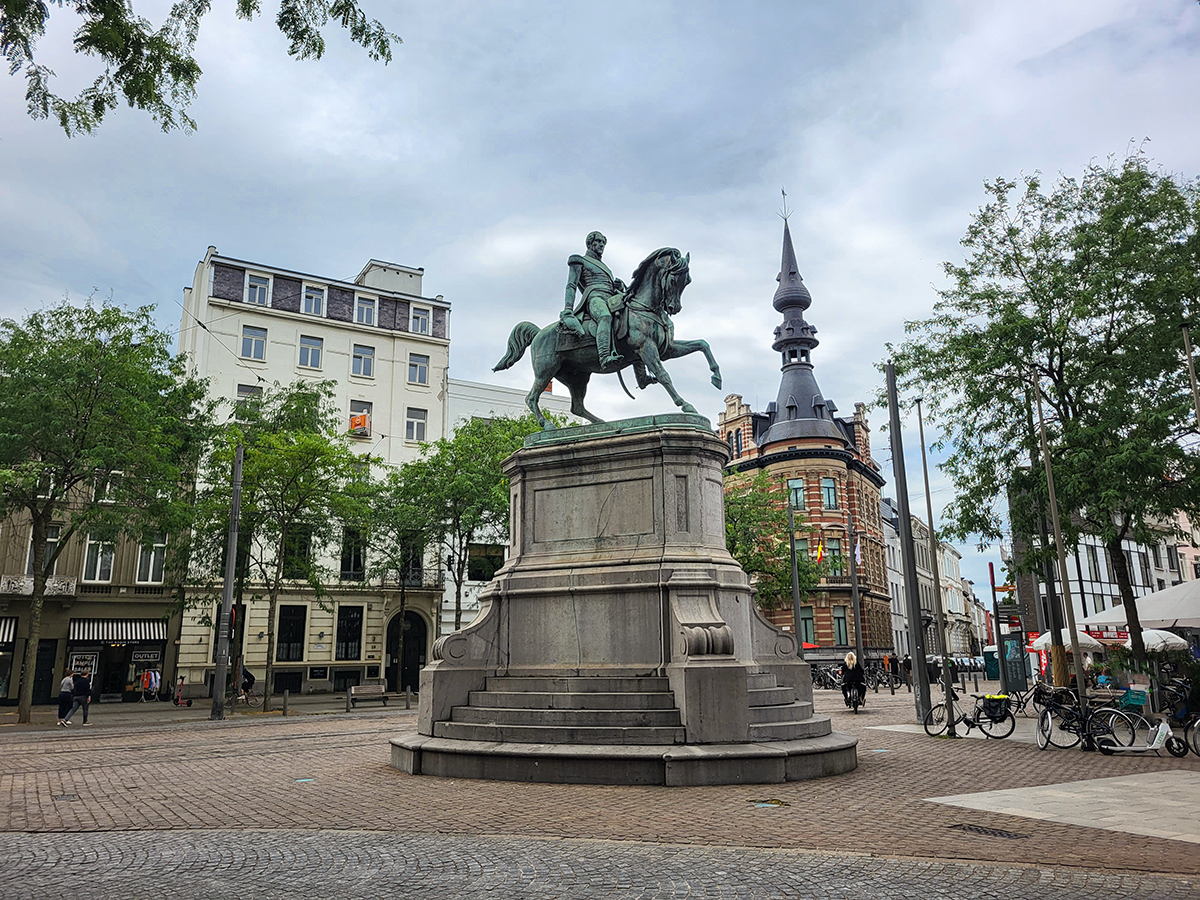
The Equestrian Statue of King Leopold I on Leopoldplaats is a striking monument both in presence and history. Mounted on a majestic horse and skillfully cast in bronze, the statue exudes dignity, authority, and the ambition of a newly founded nation. Born from the mind of renowned sculptor Joseph Geefs, it was erected in 1872 to commemorate the 25th anniversary of Leopold’s accession to the throne, and in 1873, the square, then St. Jorisplein, was renamed Leopoldplaats in his honour. Joseph Geefs (1808–1885) is notable for many public monuments and he is the brother of the artist who created the celebrated Rubens statue on Groenplaats. The king is depicted in full regal and military attire, mounted on a noble horse, suggesting both leadership and resolve.
Did you know?
- Engraved on the pedestal are French-language speeches by Leopold I, a reminder of his frequent use of French, even though he did not speak the local Dutch dialect fluently.
- Founding Monarch of Belgium (1790–1865), Leopold was selected in 1831 as the country’s first constitutional king and reigned until his death.
- With German princely heritage and experience in the Russian army, he refused Napoleon’s overtures, fought at Waterloo, and took part in the diplomatic Congress of Vienna, later becoming a key figure in European royal networks and politics.
- His family ties included being the uncle of Queen Victoria and Prince Albert, making Belgium’s first king a bridge between royal dynasties across Europe .
19. The sculpture “Aarde” by Wilfried Pas
© Photography Antranik Manukyan
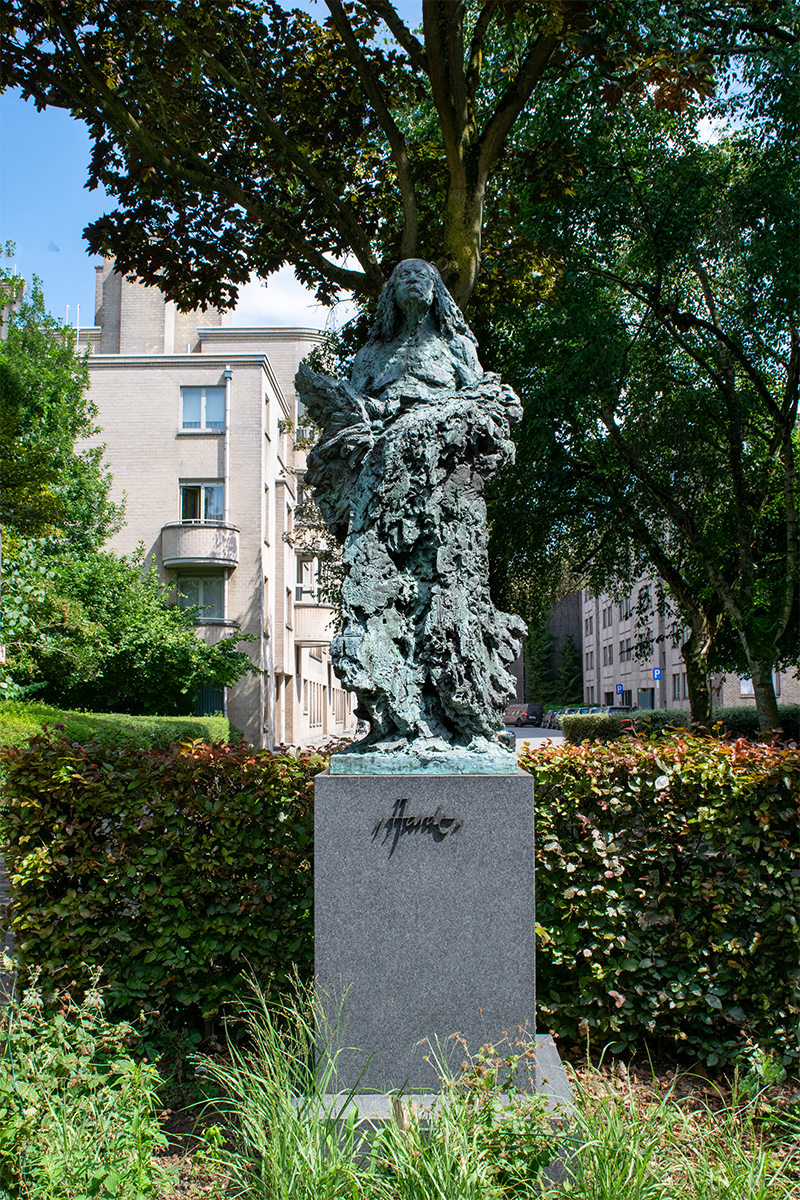
Hidden into a small green pocket between the housing blocks by Kloosterstraat, you’ll discover a striking bronze sculpture titled “Aarde” (Earth) by Wilfried Pas (1940–2017). Rather than a portrait or a figurative subject, this life‑size figure stands in solemn solidarity with the planet and the marginalized. The figure resembles a proud, older Indigenous man, is depicted shirtless, holding a fan of eagle feathers, wearing traditional adornment, and a blanket of animal skin draped around his waist.
Did you know?
- Symbolic voice: Titled “Aarde”, the sculpture reflects Pasʼ choice to foreground environmental awareness, cultural respect, and historical imbalance. The artist intended the figure as a meeting point for European self‑criticism and Indigenous self‑assertion, a silent protest sculpted in bronze.
- Born in 1940 in Londerzeel, Pas was a neo‑expressionist sculptor, draftsman, and graphic artist trained at Sint‑Lucas Brussels and the Royal Academy in Antwerp. He became a professor at the National Higher Institute in Antwerp from 1969 onward.
- Commissioned in 2009 for the 75th anniversary of the Antwerp social housing society S.M. Huisvesting, four identical copies of “Aarde” were installed in neighbourhoods where the society built homes—including one near Kloosterstraat.
20. The builders of Antwerp’s cathedral
© Photography Antranik Manukyan
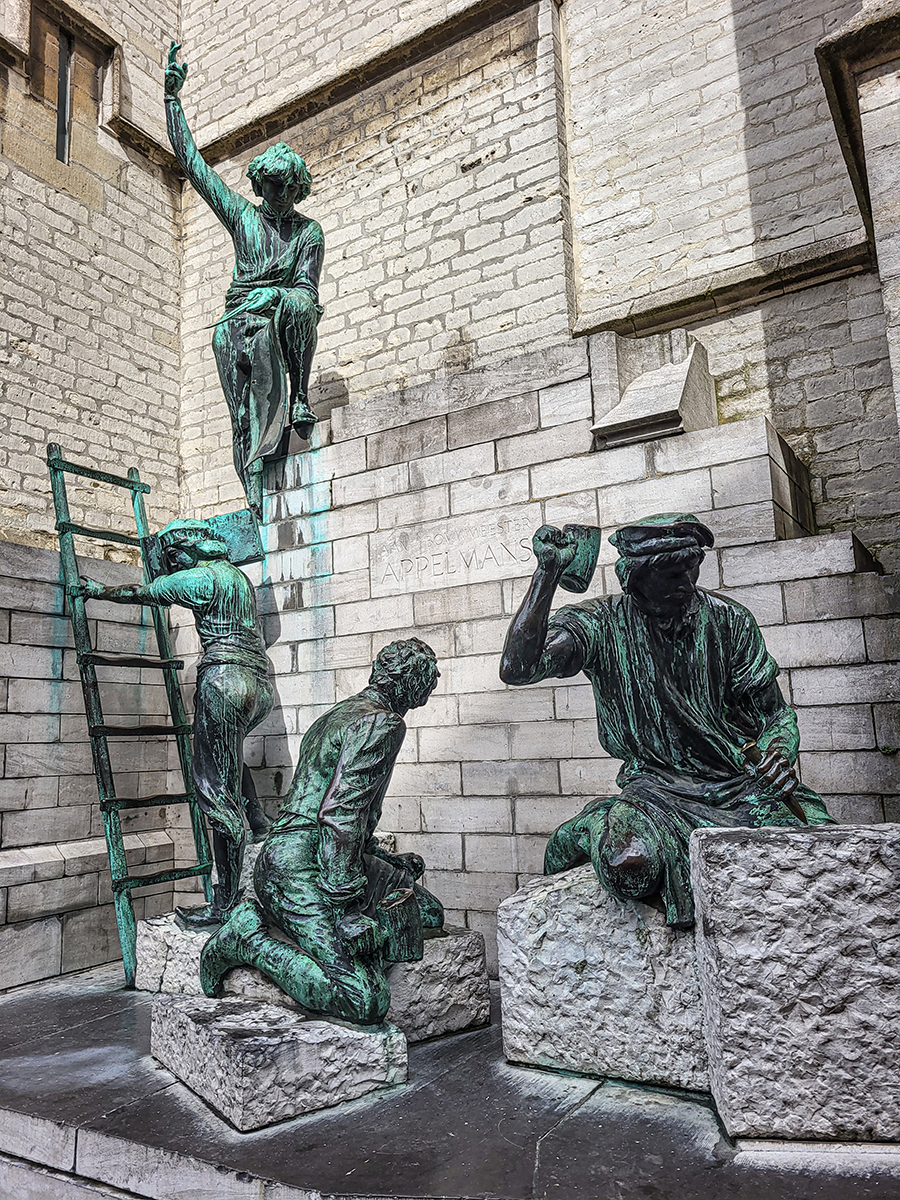
Just on the right side of the main entrance to the Cathedral of Our Lady (Onze-Lieve-Vrouwekathedraal) in Antwerp, stands the Monument to the Builders of the Cathedral, a deeply moving tribute to the stonemasons and architects who shaped this Gothic marvel. Created between 1906–1914 and designed by Belgian sculptor Jef Lambeaux, the monument depicts a dynamic scene: architect Pieter Appelmans, kneeling with cathedral plans on his knee, instructs a team of craftsmen. One figure reaches upward with chisel, another deals with the masonry, while a third steadies scaffolding, all captured in mid-action, conveying determination and collaboration. The sculptural composition resonates as a live snapshot of builders at work.
Did you know?
- The bronze figures are positioned at ground level, scaled close to life-size. They are framed elegantly against the cathedral’s limestone wall, seamlessly melding art and architecture in the urban fabric.
- Pieter Appelmans (1373–1434) and his father Jan Appelmans were the master builders behind much of the cathedral’s Gothic structure. Pieter completed the choir around 1415, devised new plans for the spires, and introduced construction techniques adapted to the frequent Scheldt floods.
- Jean (Jef) Lambeaux (1852–1908) is best known for his bold Brabo Fountain nearby. Commissioned in 1906, the monument to the builders was completed around 1914 and formally unveiled in 1935.
21. The statues of William of Orange and Philips of Marnix
© Photography Antranik Manukyan
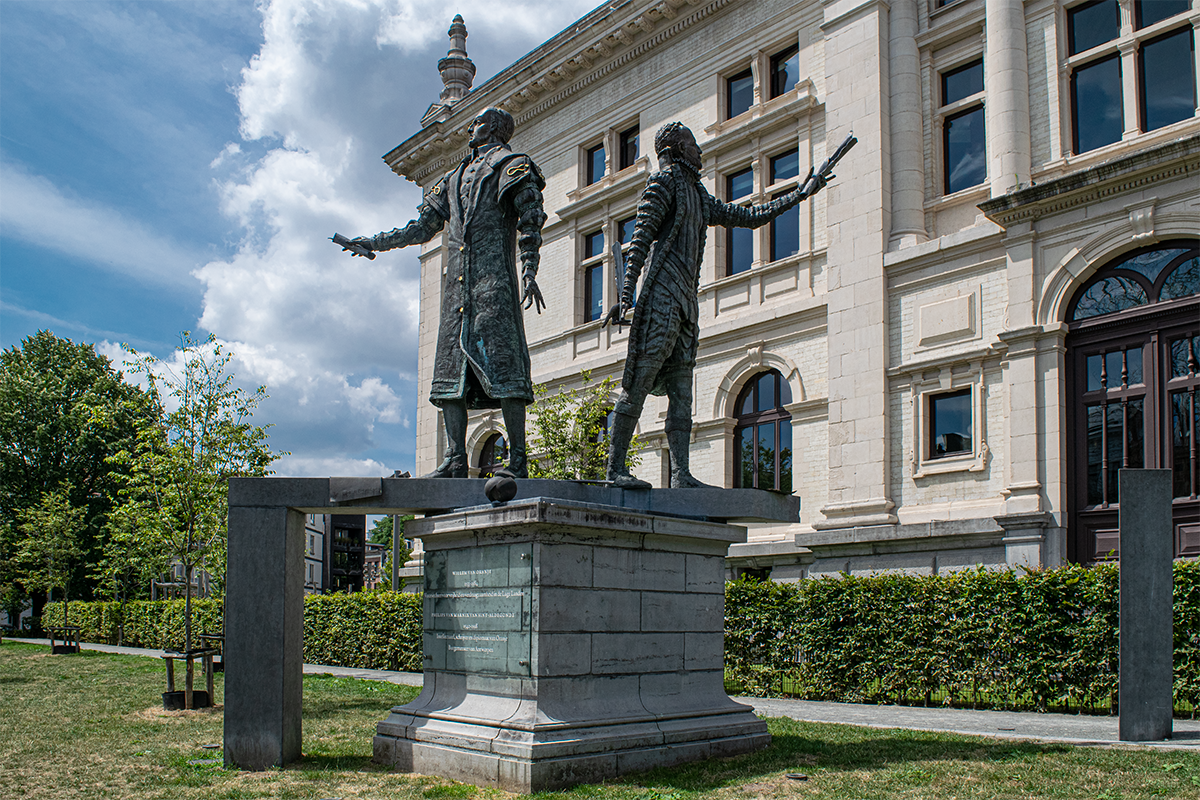
Located in the leafy expanse behind the Royal Museum of Fine Arts Antwerp (KMSKA) along Plaatsnijdersstraat, two noble bronze figures stand at about 3 meters tall, poised back‑to‑back amidst a ring of slender stone pillars. This striking monument honours William of Orange and his trusted lieutenant Philips of Marnix, Lord of Saint‑Aldegonde, crafted by Mechelen sculptor Jean‑Paul Laenen and unveiled in July 2012. William the Silent (William of Orange), the leader of the Dutch Revolt against Spanish rule, shown as a thoughtful and determined statesman. Beside him, Philips of Marnix, his trusted advisor and “buitenburgemeester” (external mayor) of Antwerp during its brief Calvinist interlude. Marnix is also traditionally credited as the possible author of the Dutch national anthem, Wilhelmus.
Did you know?
- They stand encircled by 17 blue‑stone columns, one for each of the Seventeen Provinces of the Habsburg Netherlands, symbolizing unity and historical identity.
- The monument was commissioned by the Prince William the First Memorial Foundation in The Hague, aiming to preserve the legacy of the “Father of the Fatherland” in locations meaningful to his story, including Antwerp, where he once resided near the citadel.
- Between 1577 and 1585, William established his presence in Antwerp, defending the city against Spanish forces. Marnix, appointed mayor in 1583, led the city until its fall to Alexander Farnese’s besieging troops in 1585, which marked the division between the northern and southern Netherlands.
22. The Statue of Willem Elsschot
© Photography Antranik Manukyan
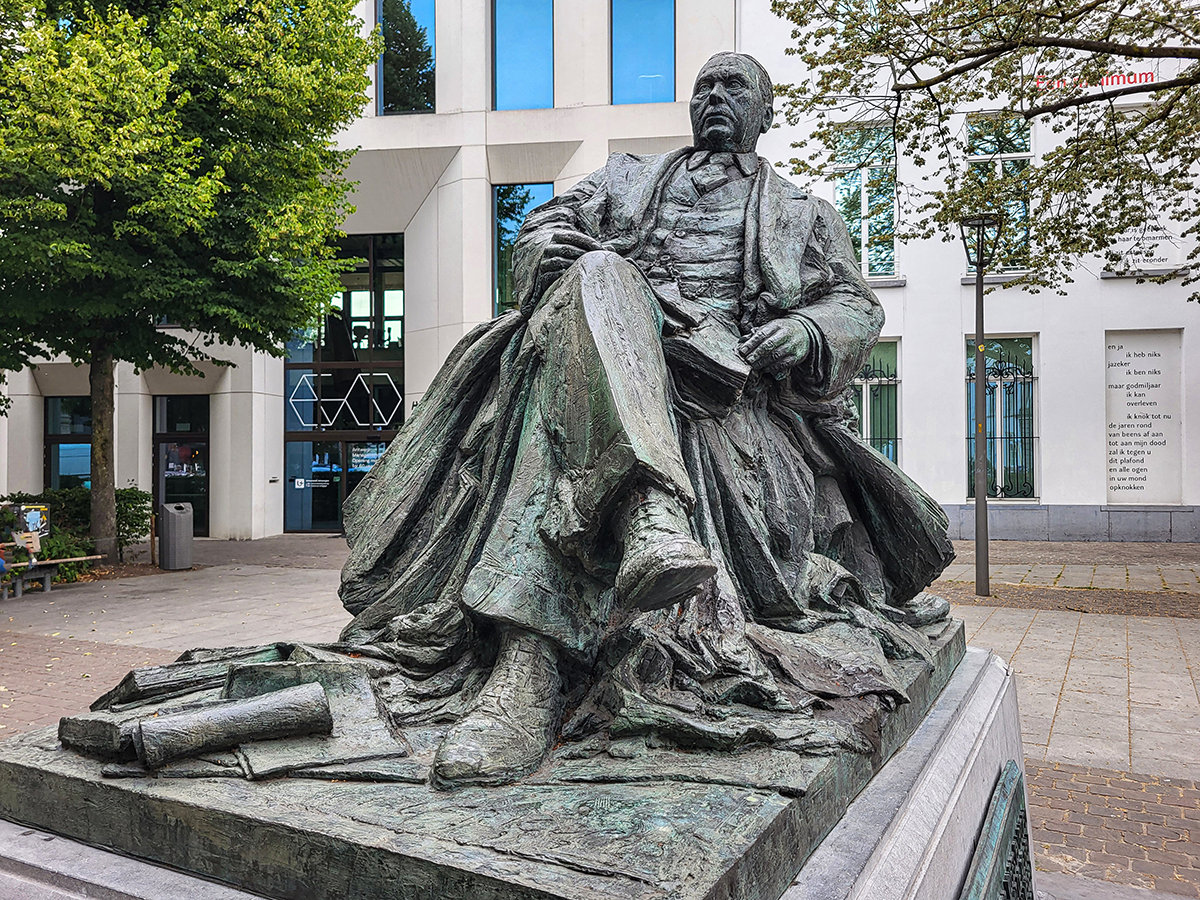
On a quiet bench near the bustling Mechelseplein in Antwerp, a familiar figure sits, pen in hand, gazing thoughtfully into the heart of the city he loved so well. This is the statue of Willem Elsschot, one of Belgium’s most beloved writers, brought to life in bronze by sculptor Wilfried Pas in 1994. Far from towering or grandiose, the sculpture is deliberately modest, like Elsschot himself, inviting passersby to sit beside him and perhaps, for a moment, share his view of the world. The statue captures Elsschot in a pose that reflects his dual life: a sharp-suited businessman with the soul of a poet. Known for his biting irony, dry humor, and melancholic charm, Elsschot turned the ordinary into the extraordinary.
Did you know?
- His most famous works, such as Kaas, Lijmen/Het Been and Villa des Roses, portray the absurdities of bourgeois life, ambition, and human frailty, often set against the very streets of Antwerp.
- Though he is now a literary icon, Elsschot was not a full-time writer. He ran an advertising agency for most of his life, which gave him firsthand experience in the worlds of commerce.
- His writing is often described as “antipoetic poetry”, deceptively simple, yet rich with emotion, irony, and humanity. He once claimed, “I write not for readers, but to relieve myself.”
23. The Monument of Theodoor van Rijswijck
© Photography Antranik Manukyan
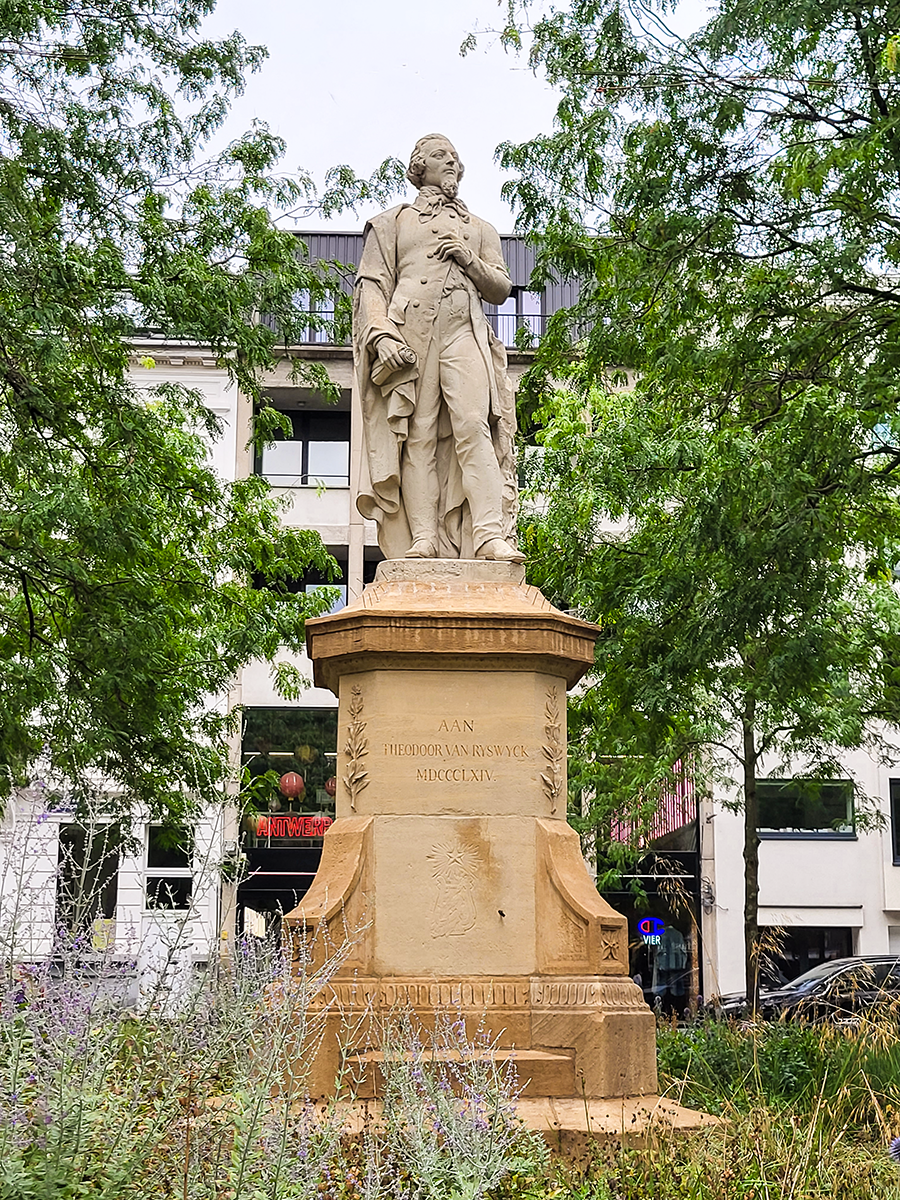
Positioned into a peaceful square just off Nationalestraat, the elegant pale-stone statue of Theodoor van Rijswijck stands atop a tall, wing-adorned plinth, as if bestowing literary wings on his beloved homeland. Erected in 1864 and relocated here in 1884, the monument honours Antwerp’s “people’s poet” with quiet dignity. Surrounded by 19th-century facades, it offers a reflective oasis celebrating a voice that spoke powerfully for everyday Flemings. A serene pause in the bustle of the city, perfect for a moment of local pride and poetic nostalgia.
Did you know?
- Born in Antwerp in 1811, Jan Theodoor van Rijswijck became a champion of the Flemish Movement, writing political satires, folk songs, and hymns in Dutch that rallied the common people and encouraged authors like Hendrik Conscience to write in Dutch.
- He volunteered during the Belgian Revolution of 1830 but soon left military life to work as a bank clerk. His true battlefield became the public stage, where he wielded his pen for cultural identity.
- He lived bohemian and often in dire poverty, loved drink, jest, and compassion for the poor. Sadly, stress from political repression led to a breakdown. He died in an asylum in 1849.
24. The War Memorial in Stadspark
© Photography Antranik Manukyan
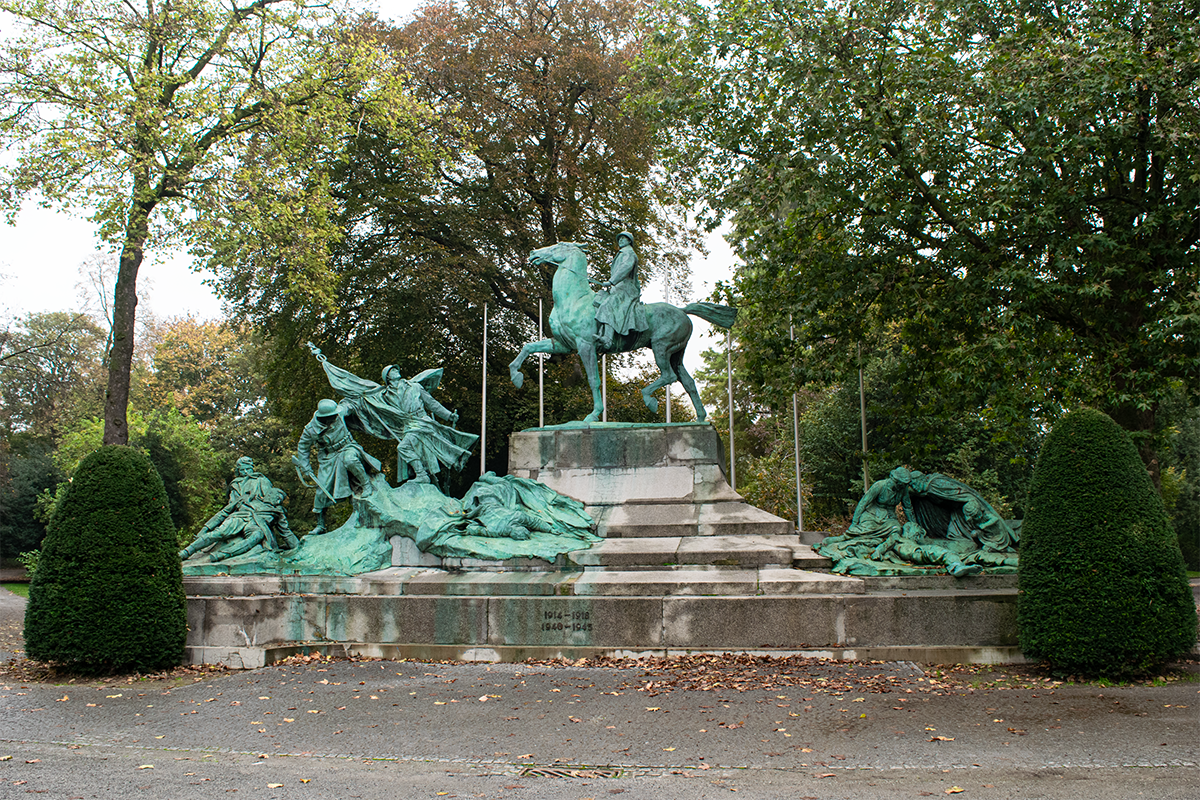
Tucked into the leafy embrace of Stadspark, at the vibrant corner of Van Eycklei and Rubenslei, stands the elegantly designed War Memorial. Crafted by sculptor Edward Deckers in 1930 and relocated here in the early 1950s, this grand bronze tableau captures the broad human tapestry of war, from the steady leadership of King Albert I astride his horse to the steadfast bravery of foot soldiers and the grief of civilians caught in the conflict. Surrounded by gentle parkland, the memorial invites reflection, the bronze figures rise above you, speaking of strength, sacrifice, and the quiet sorrow of those left behind. As branches sway overhead and sunlight dapples the stone, the monument serves as a powerful yet peaceful reminder of Antwerp’s wartime history and its ongoing journey toward peace.
Did you know?
- The memorial was the winning entry in the “Never Forget” veterans’ competition held in 1922, officially unveiled in April 1930 in the presence of King Albert I and Queen Elisabeth.
- Originally conceived to honour the Belgian soldiers who fell in World War I, the monument was later expanded to include a dedication to the victims of World War II.
- The impressive bronze sculptures depict three key war-time scenes: King Albert I heroically mounted on horseback, devoted soldiers encircling fallen comrades and a grieving family group mourning civilian loss, a visual narrative of leadership, valor, and innocence shattered
25. The statue of Paul van Ostaijen
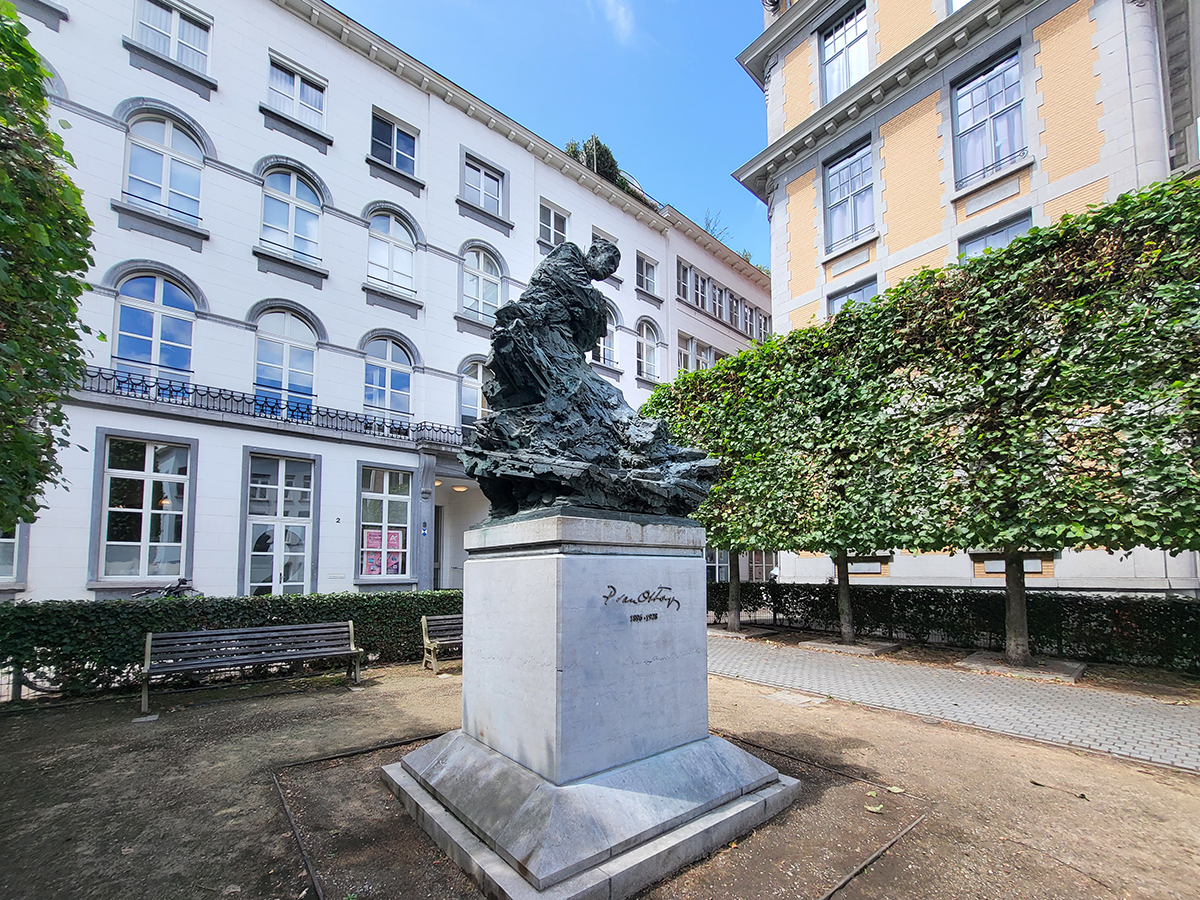
© Photography Antranik Manukyan
Tucked away in a tree‑lined nook off the bustling Minderbroedersrui, the bronze statue of Paul van Ostaijen captures the essence of Antwerp’s avant‑garde poet. Sculpted by Wilfried Pas in 1996 for his centenary celebration, the dynamic figure, leaning forward, embodies the restless energy of a creative mind always exploring new forms. His sharp coat and alert posture invite a second glance, as though he might recite a line of verse to curious passersby.
Did you know?
- Born in Antwerp in 1896 to a Dutch father and Flemish mother, he earned the nickname “Mr 1830” for strolling the city in retro 19th‑century attire, always the stylish provocateur.
- His poetry fused Modernism, Expressionism, Dada, and early Surrealism. His Berlin‑written Bezette Stad “Occupied City”, is a standout, combining collage‑style typography and sharp impressions of wartime Antwerp.
- As a flamingant activist, he supported Flemish autonomy during WWI and fled to Berlin in 1918. There he immersed himself in avant‑garde art scenes, returning in 1921 after amnesty.
26. The statue of Gerard Walschap
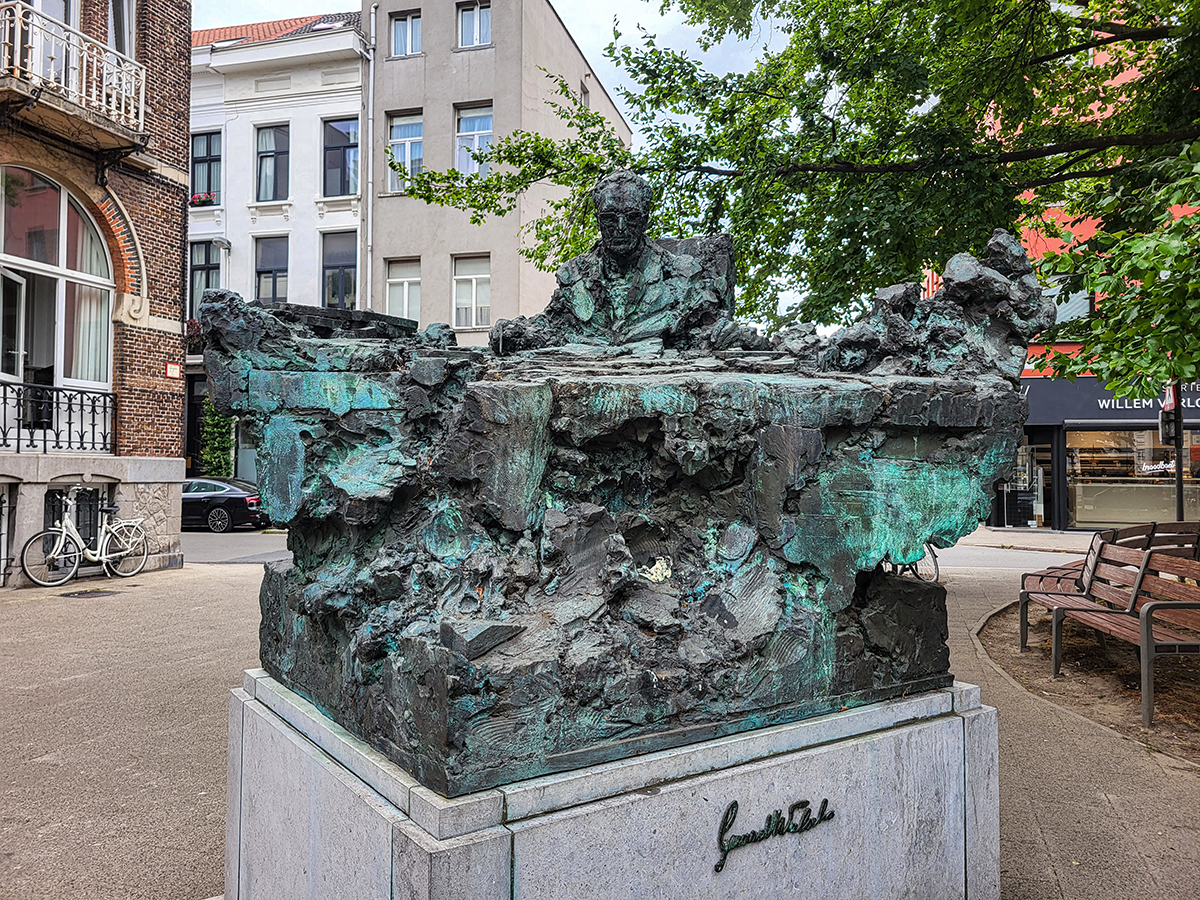
© Photography Antranik Manukyan
Nestled at the charming corner of Schermersstraat and Maarschalk Gerardstraat in Antwerp stands a graceful tribute to one of Flanders’ literary giants, the bronze statue of Gerard Walschap, crafted by sculptor Wilfried Pas in 2005. This statue presents Walschap deep in thought, seated at his writing desk, evocative of his life as a reflective and bold man of letters.
Did you know?
- He received honours like Grand Officer of the Order of the Crown and was knighted in 1975, earning the title Baron Walschap.
- In 1968, he was awarded the prestigious “Prijs der Nederlandse Letteren”, and he was nominated for the Nobel Prize multiple times.
- Walschap began with romantic, faith-inflected poetry and plays. His first novel Waldo appeared in 1928, but it was Adelaïde that sparked controversy, so critical of the Church that it ended up on the Index Librorum Prohibitorum. The backlash led him to abandon his faith entirely, turning into a staunch secular humanist.
27. The Baron Lambermont Monument
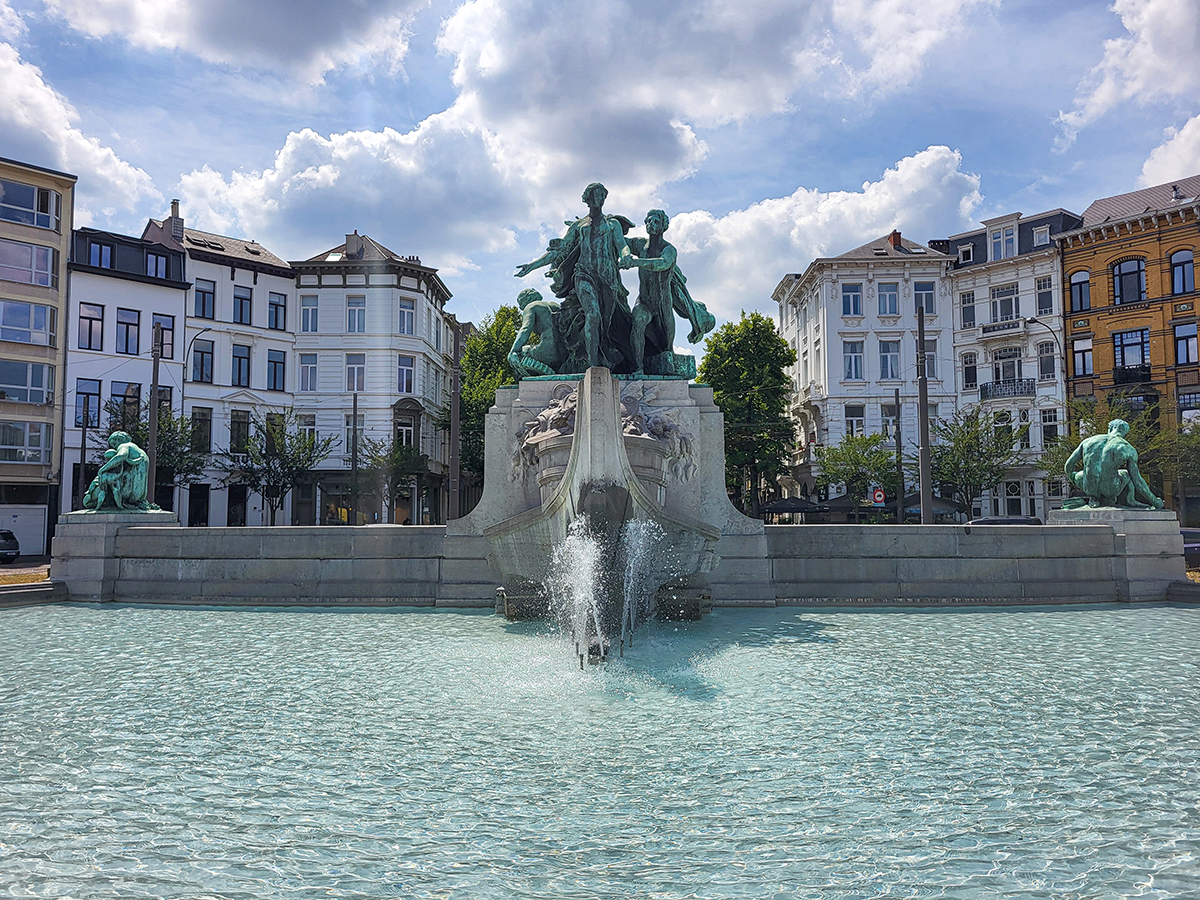
© Photography Antranik Manukyan
At the heart of the leafy Lambermontplaats in Antwerp’s Zuid district, a stately bronze figure stands atop a tall plinth, surrounded by the soft bustle of cafés, bicycles, and tree-shaded benches. This is the Baron Lambermont Monument, a graceful homage to Auguste, Baron Lambermont (1819–1905), a man whose diplomatic brilliance helped shape the future of Antwerp and Belgium without ever raising his voice. Sculpted by Thomas Vinçotte and inaugurated in 1912, the monument depicts Lambermont as a dignified statesman, holding a scroll that symbolizes treaties and negotiations, the tools of his trade. His posture is calm, almost understated, much like the man himself, who preferred diplomacy over drama and earned international respect not through power, but through quiet perseverance.
Did you know?
- Born in Dion-le-Val in 1819, Lambermont entered public service at a time when Belgium was still a young and fragile nation. He rose through the ranks to become one of the country’s most respected diplomats and government advisors.
- His most celebrated achievement was negotiating the abolition of the Scheldt River tolls in 1863. For centuries, foreign powers had imposed fees on ships using the Scheldt, limiting Antwerp’s ability to thrive as a port. Lambermont’s quiet but relentless diplomacy freed the river, opening Antwerp to international trade and transforming it into one of Europe’s great harbours. This achievement was so significant that Lambermont earned the affectionate title of “The Liberator of the Scheldt.”
- He also played key roles in representing Belgium at major international conferences, including the Congress of Berlin in 1878, always defending Belgian neutrality, sovereignty, and liberal values with remarkable poise.
28. The Fishing-Eagle sculpture “Vissende Arend”

© Photography Antranik Manukyan
Perched with majestic intensity on a small plaza at the intersection of Wapper and Meir, the Vissende Arend fountain statue captures a frozen moment of nature in action. This impressive bronze eagle, wings fully outstretched and talons clamped around a hefty fish, seems to hover just above glistening water, as though it has paused mid-capture, ready to lift off again. Crafted by the celebrated Danish sculptor Hugo Liisberg (1898–1958), the eagle was initially designed as a winning entry for a fountain competition in Silkeborg, Denmark. A copy was acquired by the Open-Air Sculpture Museum Middelheim in 1951, and in May 1980, the bronze version was installed at its current Antwerp location.
Did you know?
- Liisberg was known for his lifelike animal sculptures, often inspired by nature and zoo studies, and was awarded the prestigious Eckersberg Medal in 1942 by the Royal Danish Academy of Fine Arts.
- Installed in a busy pedestrian zone, the eagle symbolizes vigilance, precision, and nature reclaimed downtown.
- Hidden just beyond the Meir shopping street, it brings a thrilling pause in the midst of urban bustle.
29. The statue of Our Lady
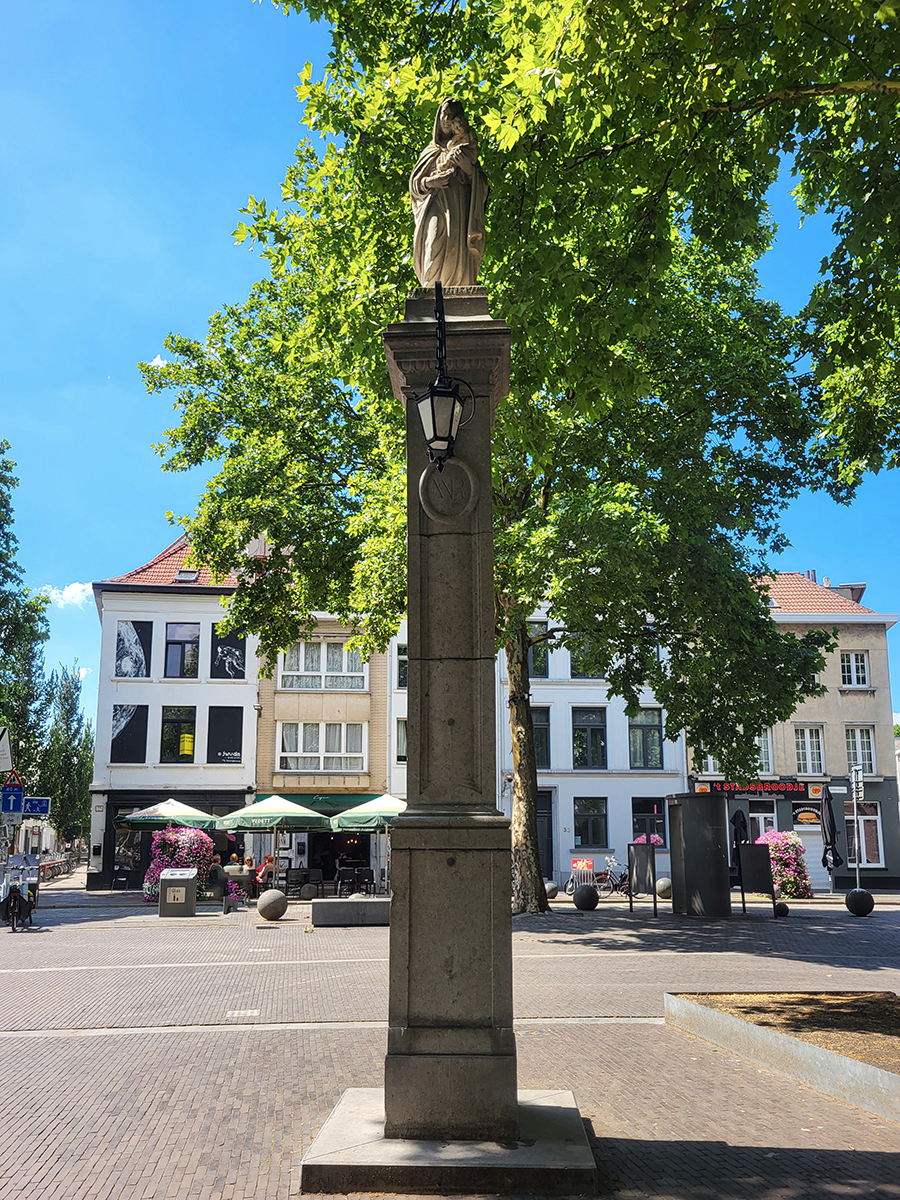
© Photography Antranik Manukyan
Rising on a tall stone column in the open space of Ossenmarkt, the serene statue of Our Lady with Child is both a spiritual symbol and a piece of Antwerp’s living history. Cradling the Christ Child on her left arm and crowned with gentle dignity, she gazes protectively across the square, timeless in her quiet presence. A decorative lantern arm extends beside her, recalling a time when such statues served as both devotional icons and street lights for neighbourhood safety. At the base of the column, a Marian monogram medallion faces front, while the year 1716 is etched on the back.
Did you know?
- The current natural stone sculpture by Floris De Cuyper (1875–1965) was installed in May 1947, after the column itself was rebuilt and moved to the center of the square following postwar urban changes.
- It replaced an earlier version from around 1814, erected after the French administration’s secular period disrupted local traditions. By mid‑century, the original Madonna had suffered damage, including the loss of the Child’s head in 1921 and again by 1944.
- Following a blaze in 1977, the statue endured further harm and was carefully restored in 2007. The preservation project addressed chipped features, renewed the lantern mechanism, and reinforced the column’s structural integrity.
30. The Belgisch-Congo Monument
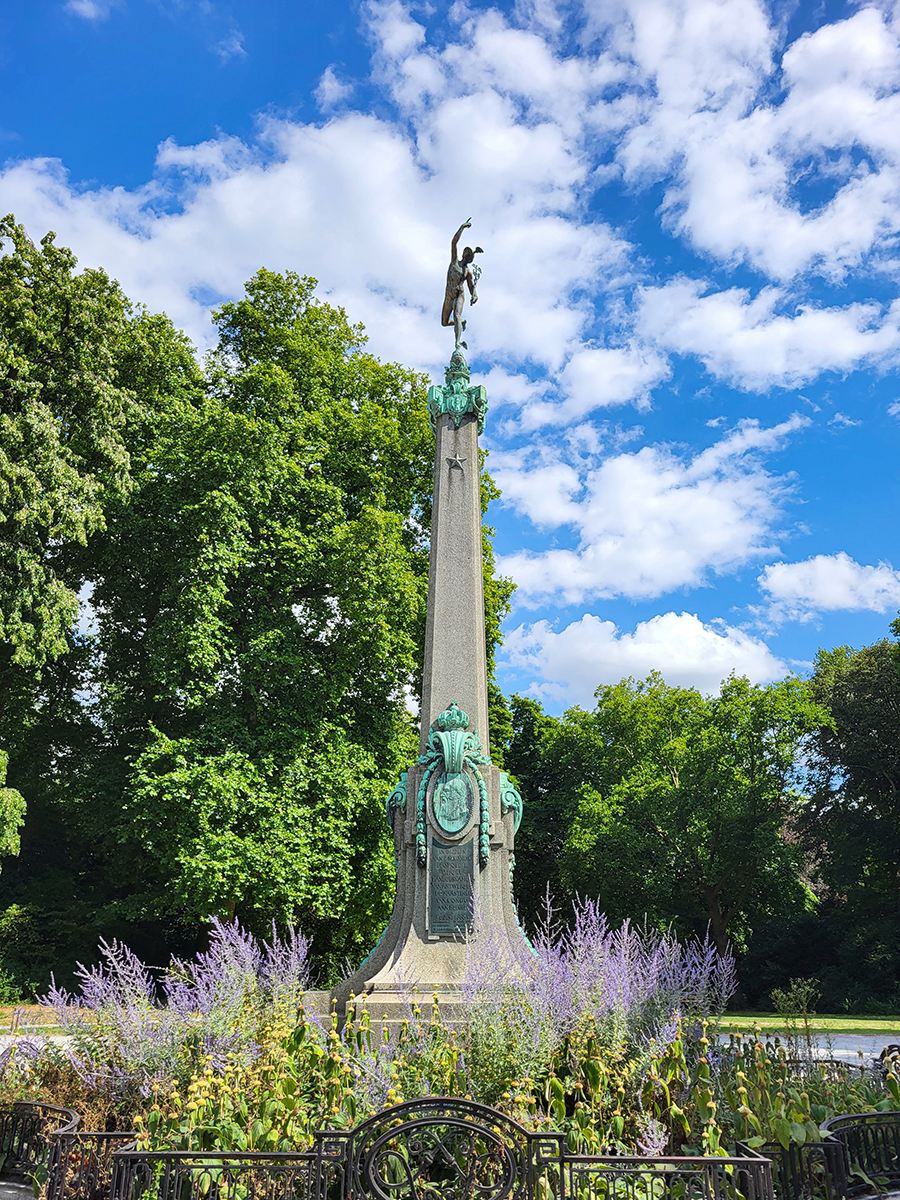
© Photography Antranik Manukyan
Nestled amid the greenery of Stadspark on the elegant Rubenslei, the Belgisch‑Congo monument soars as a tall granite obelisk, its formal lines and ornamental bronze details combining patriotism with colonial ambition. Designed by Emiel Van Averbeke, Antwerp’s city architect, and sculpted by Jules Baetes and Jan Baptist Kerckx, the monument was unveiled in 1911 to commemorate Belgium’s annexation of the Congo Free State, later Belgian Congo in 1908. Its base is richly decorated with bronze volutes and garlands, presenting a crowned portrait medallion of King Leopold II on the front and the Mercury emblem of the Antwerp Chamber of Commerce on the back. Above them, bilingual dedication plaques in Dutch and French note the 1909 ceremony that took place in Leopold’s presence.
Did you know?
- Topping the obelisk is a gilded bronze Mercurius figure, modelled after the famous 16th-century bronze by Giambologna, standing gracefully on a sphere, staff in hand, symbolizing commerce and civilization amidst colonial narrative.
- The initiative for the monument came from Antwerp’s Chamber of Commerce after a 1909 procession commemorating Congo’s annexation. Sculptor Jules Baetes, already a designer of medals and ceremonial events, was tapped to create the monument; Van Averbeke provided its architectural framework, while Kerckx handled ornamentation.
- Completed in September 1911, it was formally handed over to the city the following month. Surrounding planting and a Neo‑Louis XVI wrought‑iron balustrade, including Leopold II’s double‑L monogram, were finished by 1914, enclosing a flowerbed and creating a dignified urban monument space.
- In recent decades, the monument has drawn growing scrutiny and critique. Its glorification of colonial rule and depiction of pulp colonial propaganda, especially the portrayal of Congo as a Belgian “civilizing mission”, has been increasingly controversial.
31. The statue of Antwerp's Harbour Girl
© Photography Antranik Manukyan
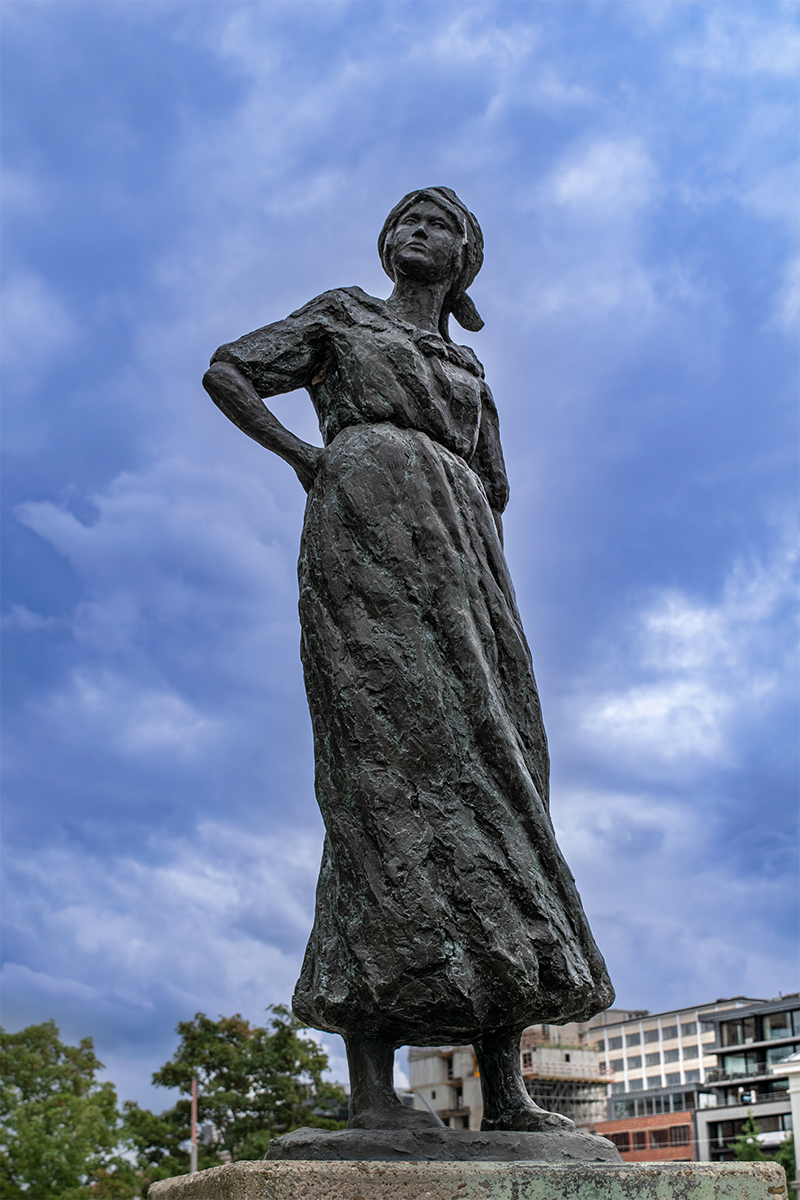
She stands tall against the changing sky, feet planted firmly on Antwerp’s historic harbourfront, gazing upward with quiet resolve. This is Het Antwerpse Havenmeisje, the Antwerp Harbour Girl, a powerful tribute sculpted by Patrick Janssens, inspired by the compelling sketches of Eugeen Van Mieghem, the artist of Antwerp’s working class. There is no basket, no demure glance, only strength. With hands on her hips and her chin lifted, she embodies the resilience of the women who once lived and laboured around the bustling docks. These were fishwives, washerwomen, mothers, daughters, figures who carried the invisible weight of daily life while the ships came and went.
Did you know?
- Unlike romanticized monuments, this statue speaks with honesty and respect. Her long skirt ripples with texture, her scarf tied practically around her head, she is both ordinary and unforgettable.
- Through her posture and presence, she commands recognition not for wealth or fame, but for dignity, endurance, and human spirit.
- Placed fittingly in Eilandje, near the water that shaped so many lives, Het Havenmeisje stands not just as a memory, but as a symbol of strength, pride, and the quiet power of Antwerp’s harbour women.
32. The statue of the Lange Wapper

© Photography Antranik Manukyan
At the foot of Het Steen, Antwerp’s oldest fortress, stands a towering and mischievous figure from Flemish folklore, the statue of Lange Wapper, a beloved trickster giant whose name still echoes through local legend. Created by artist Albert Poels in 1963, this bronze sculpture captures the moment Lange Wapper gleefully scares two drunkards, looming over them with his trademark mischievous grin and long limbs stretched wide. Lange Wapper is a mythical character known for his ability to grow to enormous size and play tricks on drunkards, cheaters, and those lacking manners, often appearing suddenly to frighten wrongdoers.
Did you know?
- According to the legend, he could leap across the River Scheldt in one stride and disguise himself as anything, from a small child to a towering giant, a true shape-shifter with a moral mission.
- The statue’s location at Het Steen, near the entrance to the historical old town, is symbolic: this is where the tales of Lange Wapper often unfold, in the twilight of medieval alleyways and near the water’s edge.
- Children gaze in awe; adults smile with nostalgia. The scene depicted in the sculpture adds a touch of playful eeriness to the city, reminding visitors that Antwerp’s charm includes not only beauty and history, but also humour and legend.
33. The Monument for the Fallen Belgian Sailors
© Photography Antranik Manukyan
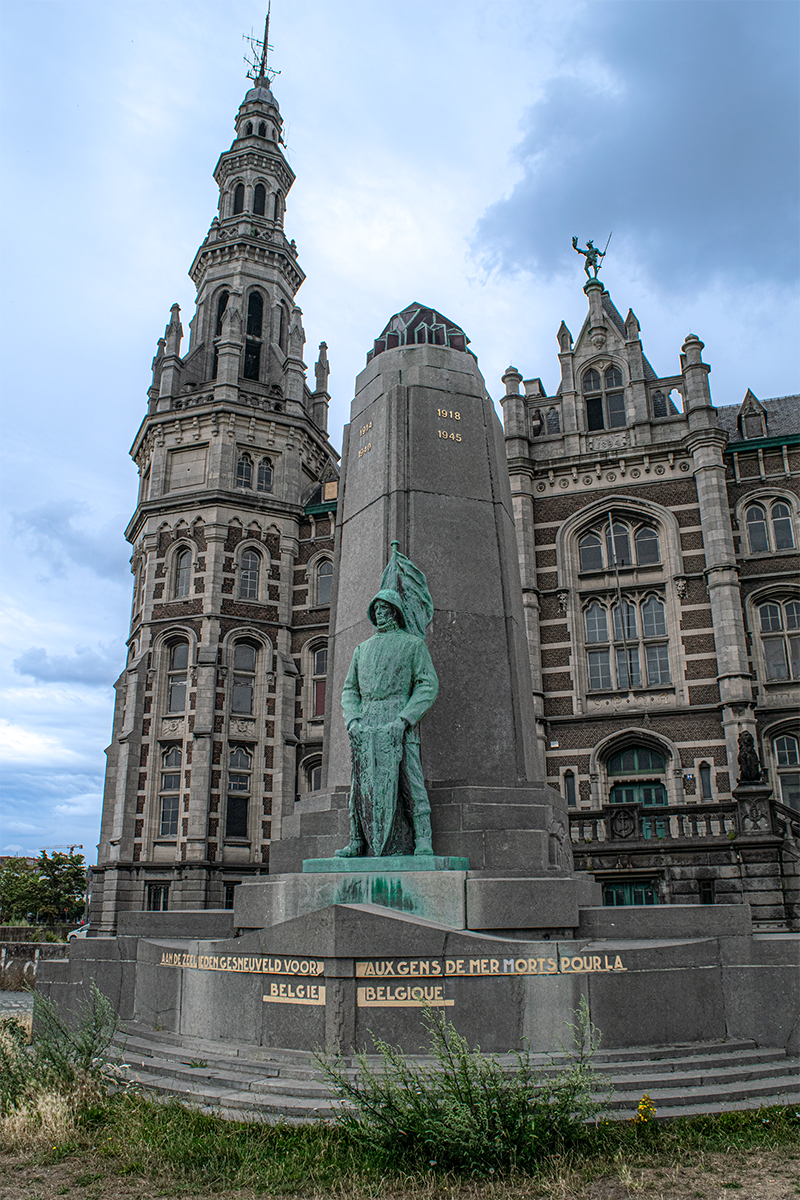
Located at the water’s edge on Tavernierkaai in Antwerp’s historic port quarter, the Monument to the Fallen Belgian Sailors pays tribute to seafarers lost in both World War I and World War II. Against the backdrop of the stately Loodswezen Pilotage Building, the memorial is anchored by a solemn, weathered-bronze figure of a sailor dressed in traditional maritime attire, heavy coat and cap, standing upright in contemplative repose rather than heroic dramatization. The monument’s inscriptions, in gilded letters, evoke the names, service, and sacrifice of Belgian sailors who perished in wartime. Rather than dynamic or embellished sculptural gestures, the figure’s simple stance and steadfast gaze emphasize endurance and remembrance.
Did you know?
- The memorial was officially inaugurated on 28 September 1930, located at Tavernierkaai, between the Loodswezen Pilotage Building and the Scheldt River.
- The monument’s design was the winning entry in a city-organized competition by sculptor Simon Goossens (1893–1964) from Sint-Lenaarts, working in Antwerp.
- The bronze figure and sculptural elements were cast by the foundry Ed. Lesetre et Cie, based in Brussels; this casting signature is visible on both the base and the bronze statue.
34. The statues around Willemdok
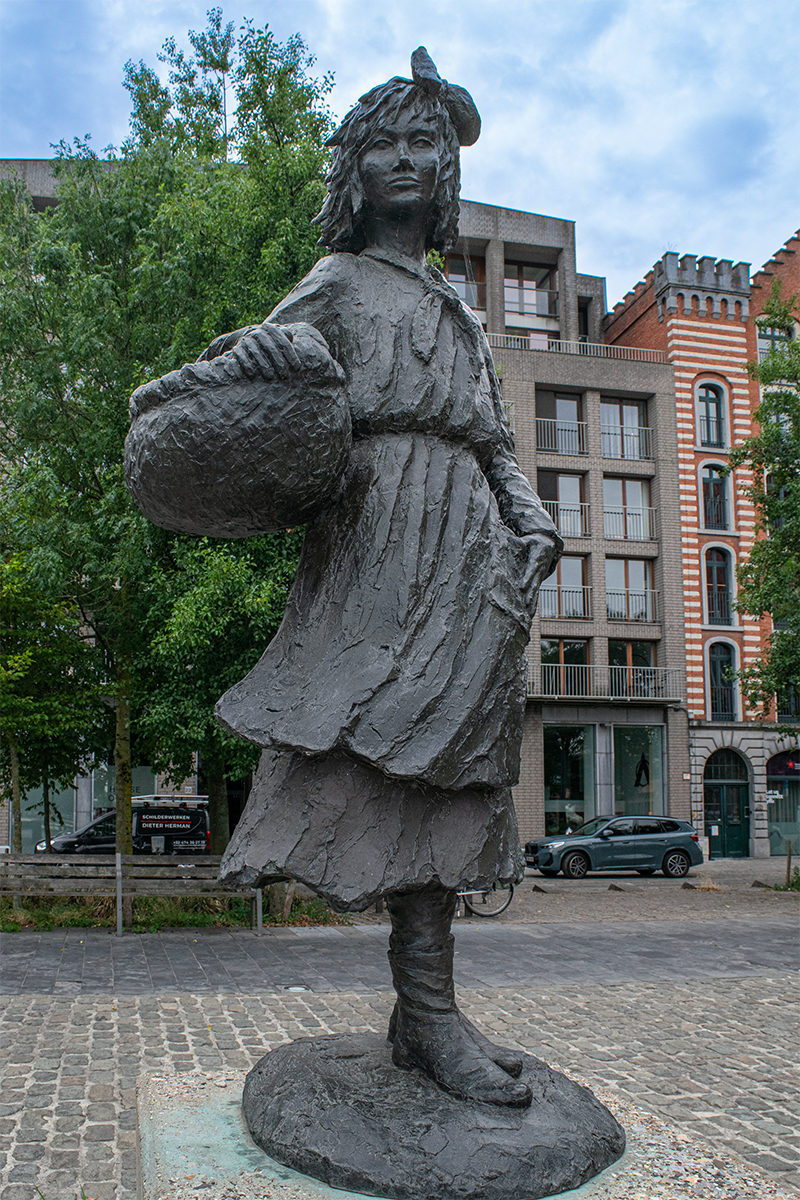
Wiske: A Harbour Girl Remembered
Statue by Carla Kamphuis-Meijer, based on the real model drawn by Eugeen Van Mieghem. Her name is Wiske, and unlike many symbolic statues, Wiske was real, a true child of the quays, once living, once laughing, once sketched in charcoal and chalk on yellowed paper by the harbour’s most devoted chronicler.
The Statue of Augustine Pautre
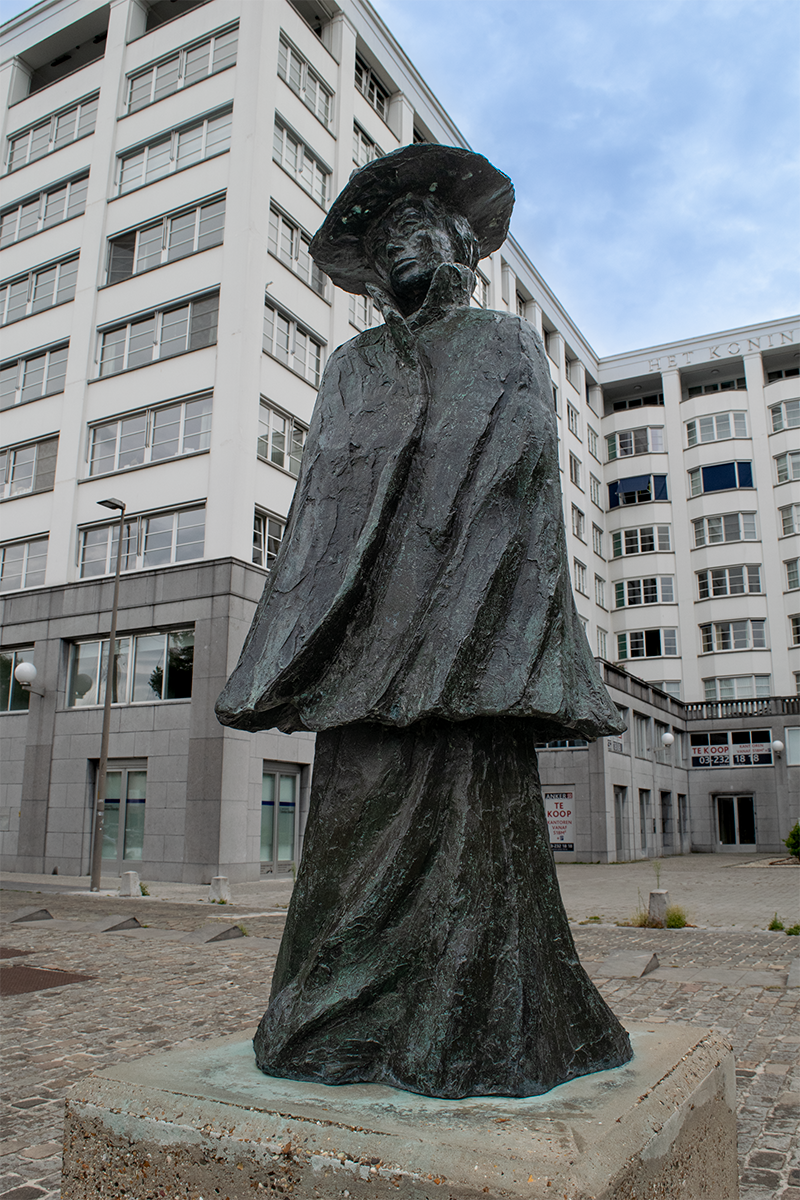
In the quiet curve of Antwerp’s harbour, where the wind still carries echoes of departing ships, a solitary bronze figure gazes softly outward. This is Augustine Pautre, captured in gentle permanence by the artist who loved her, Eugeen Van Mieghem. She was Van Mieghem’s wife, his muse, and the emotional heart of many of his most intimate works.
Jan Van Rijswijck: The Visionary Mayor of Antwerp
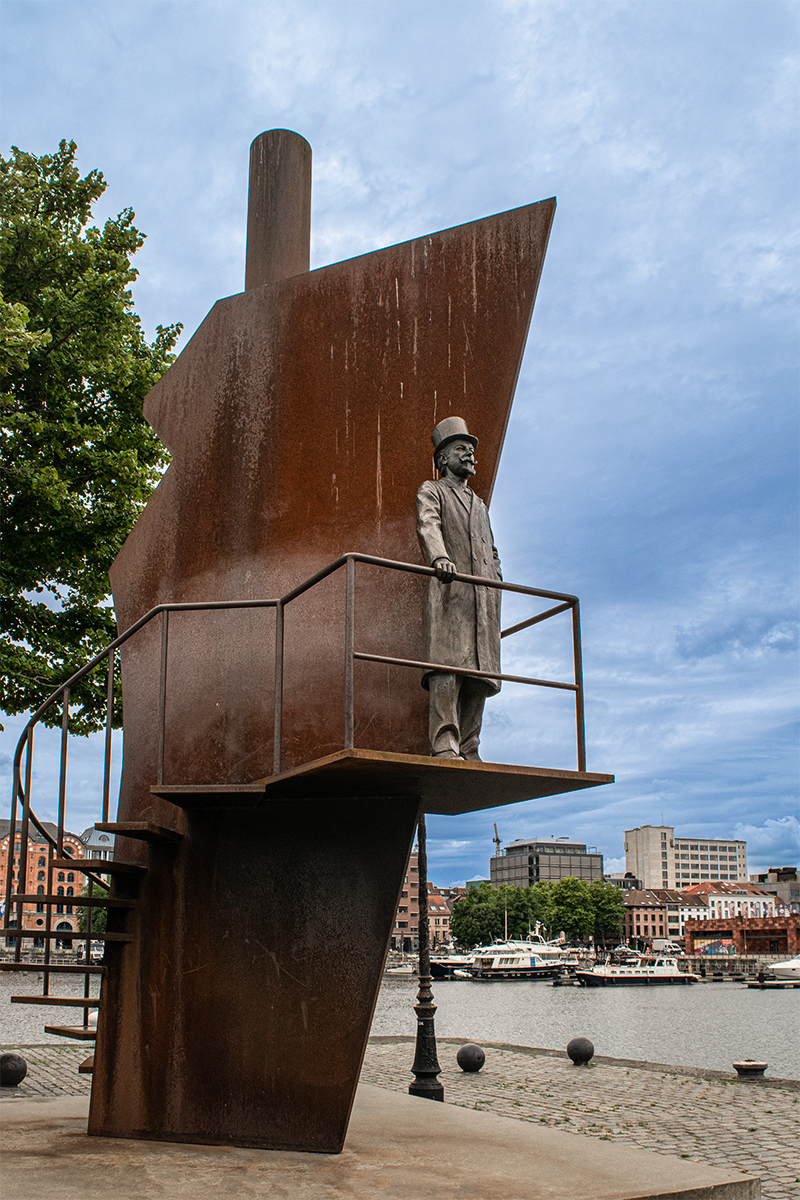
At the entrance to Antwerp’s old harbour quarter, a lively bronze figure steps forward with style—coat flaring, top hat tipped back, papers in hand. This is Jan Van Rijswijck (1853–1906), one of Antwerp’s most influential mayors, reimagined with playful flair by renowned Belgian sculptor Tom Frantzen.
The Harbour Rascal
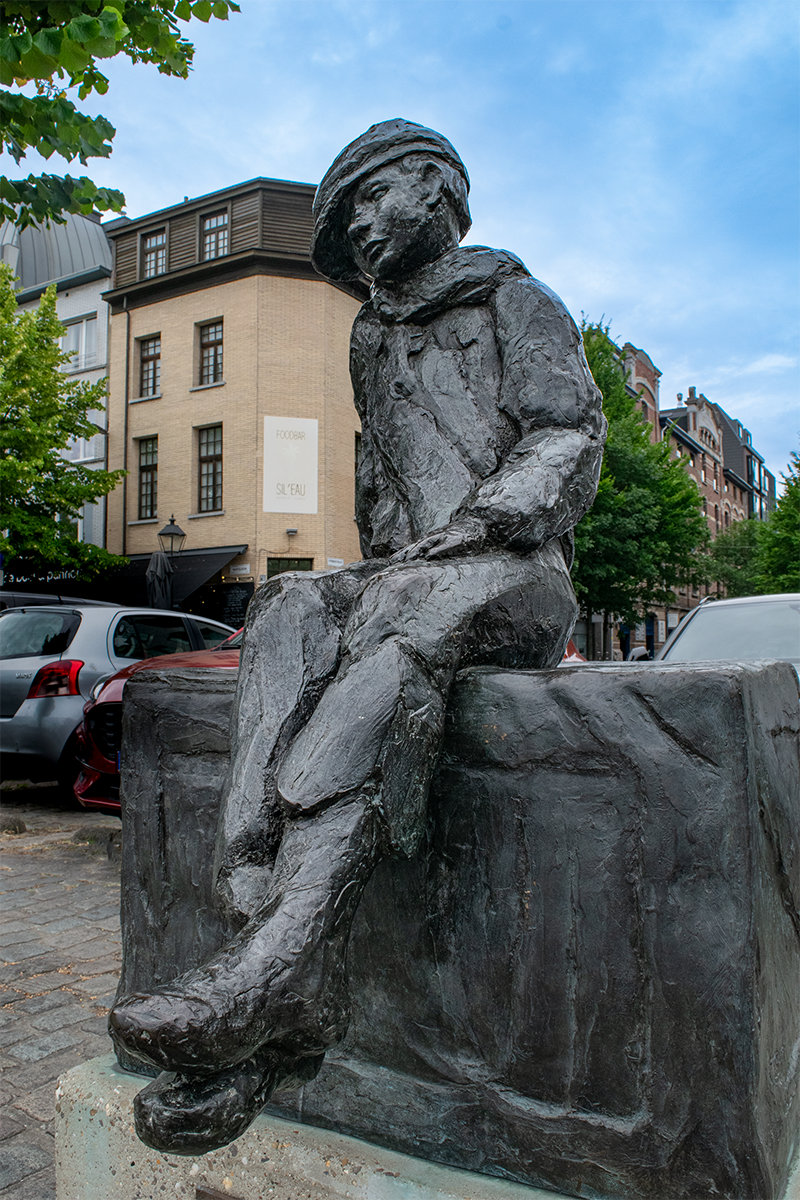
At the vibrant Eilandje, near Antwerp’s historic docks, stands the lively bronze statue of “Het Havenboefje”, literally “The Harbour Rascal.” This charming sculpture depicts a boy in rolled-up trousers, captured mid-step as if about to dart off on some playful mischief.
35. The statues outside the Royal Museum of Fine Arts
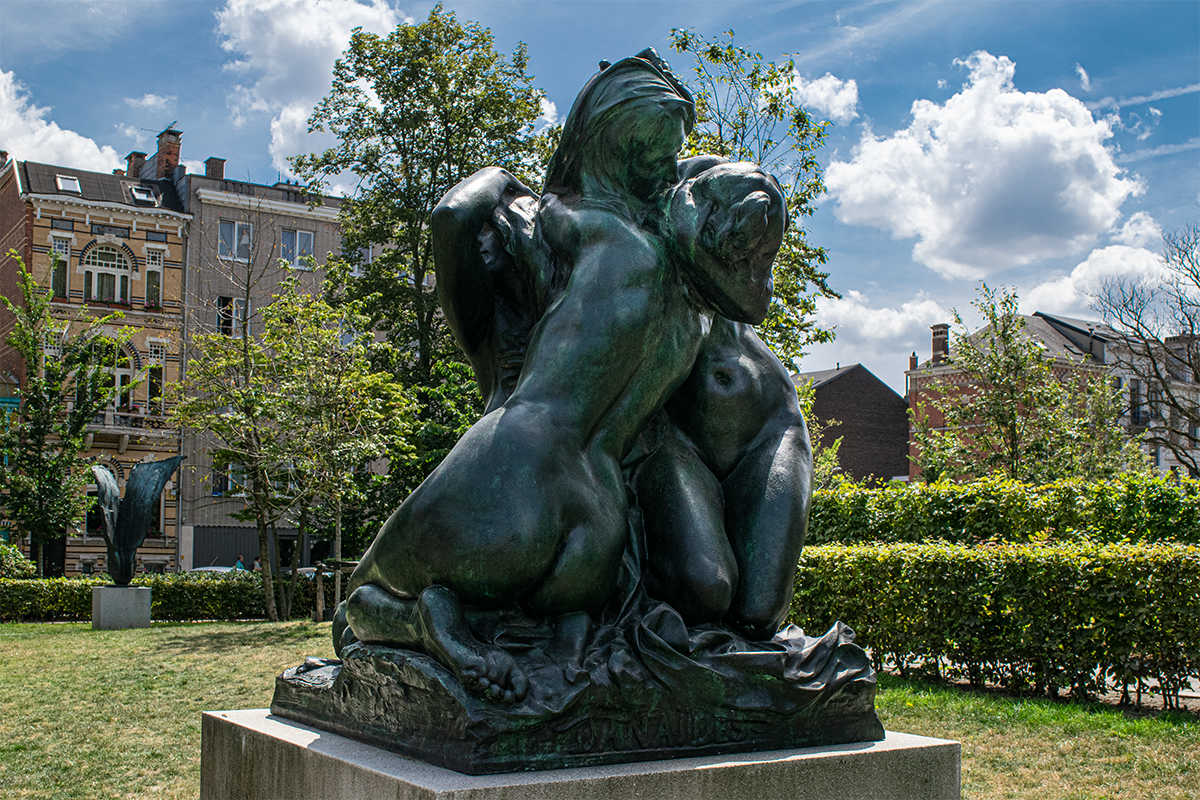
Danaïdes by Jacques Marin (1901)
The piece represents the mythological Danaïdes, the daughters of Danaus sentenced to eternally fill leaking vessels—a potent symbol of futile labour and endless suffering. Marin was a notable Belgian sculptor and medallist, trained at the Royal Academy of Fine Arts in Brussels, and became known for his allegorical and Symbolist works (particularly female figures).
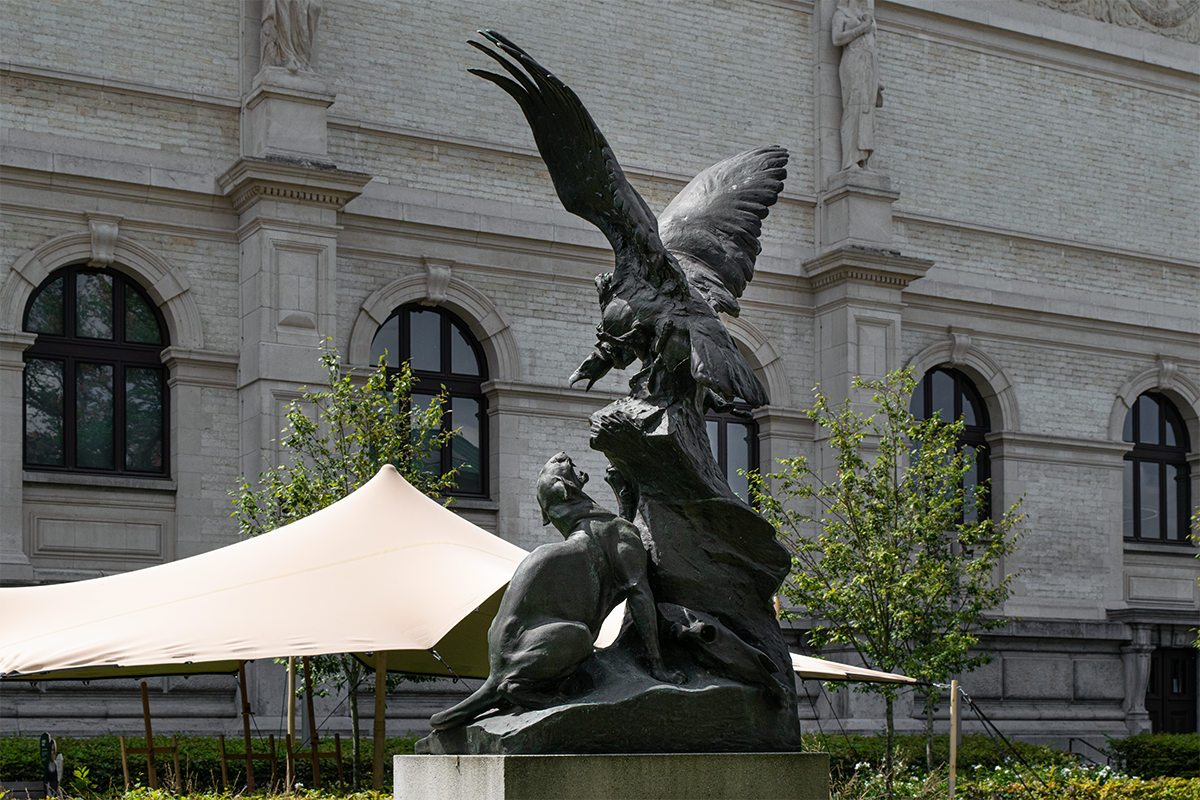
Vulture Protecting its Prey (Gier die zijn prooi verdedigt) by Josué Dupon
The dramatic bronze depicts a vulture fiercely defending its prey, bristling with animalistic tension and raw power. Its pose and anatomy reflect Dupon’s mastery of animal form and dynamic realism. Dupon’s work combines sculptural strength with psychological drama, often cast in large scale and expressive poses—a hallmark of his signature style. After the museum acquired “Gier die zijn prooi verdedigt”, Dupon’s career took an important turn: he began receiving public monument commissions, won official honours, and was appointed professor at the Antwerp Academy.
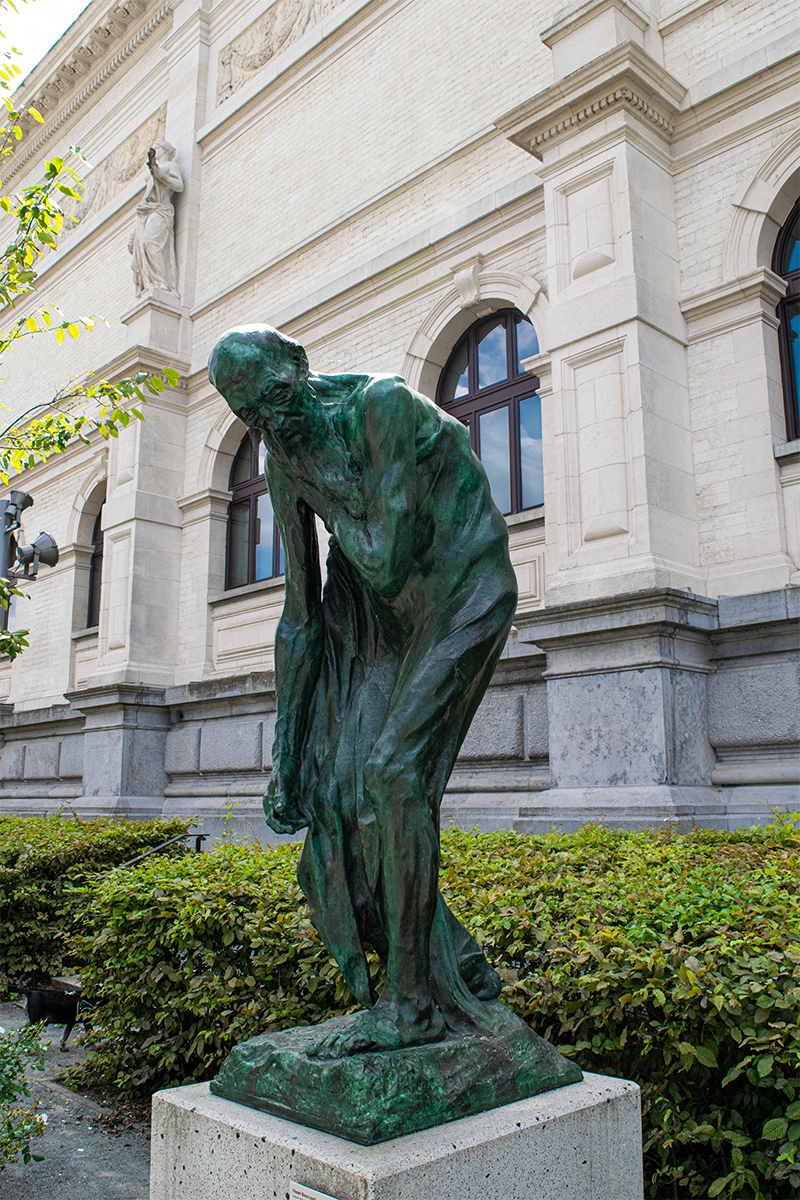
The Solitary (De eenzame) – Henri Boncquet (1894)
The Solitary presents a lone, introspective figure in a quiet, contemplative pose—a powerful evocation of emotional isolation and inner reflection. Born in Ardooie, West Flanders, Boncquet studied sculpture and became known for deeply expressive bronze and marble works. He won the Belgian Prix de Rome in 1897, which allowed him to study in Rome, and went on to receive commissions for public monuments in Brussels, Antwerp, and beyond.
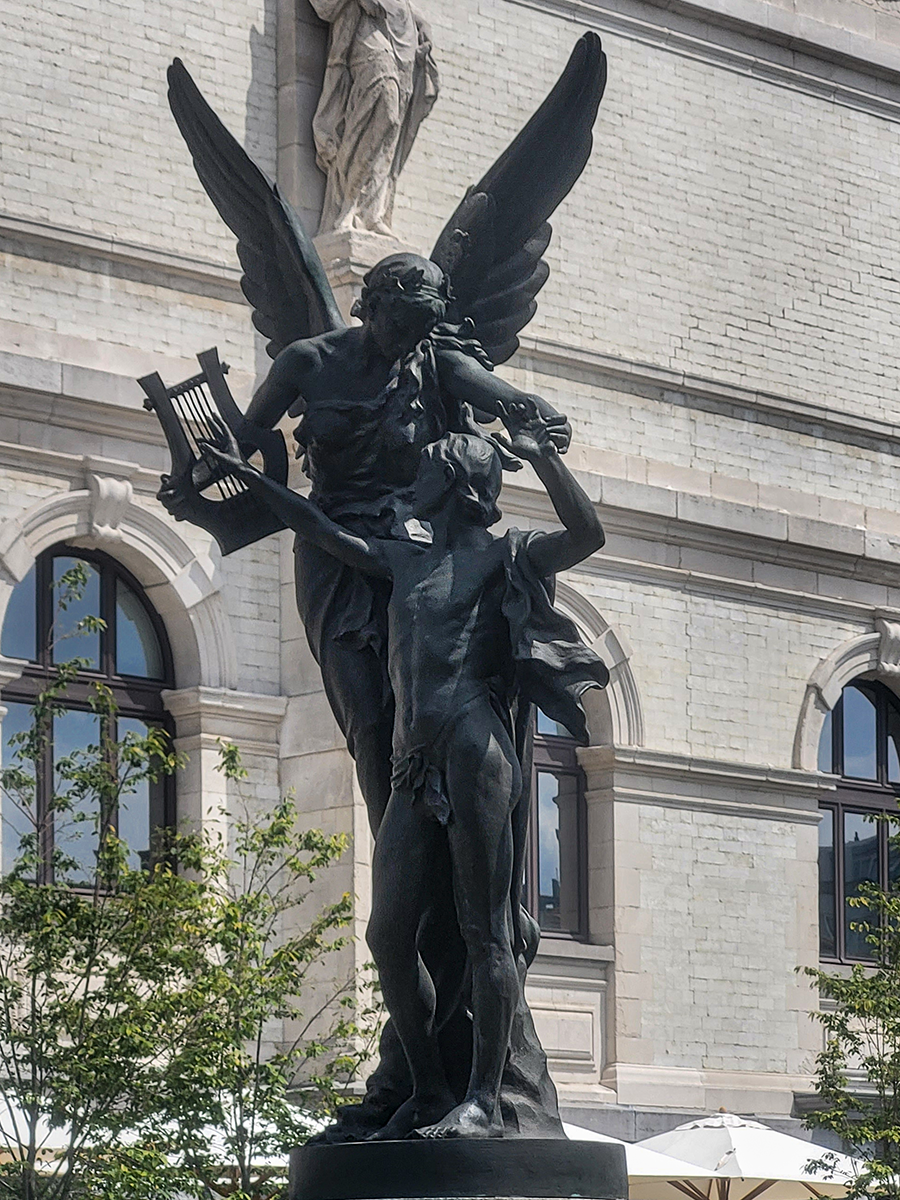
Poetry (Poëzie) by Jan Frans Deckers (1888)
Poëzie is an allegorical nude, subtly modest, blending classical idealism with romantic emotion. Its title suggests an embodiment of literary or artistic expression in human form, a theme typical of Deckers’s focus on poetic and symbolic motifs. Deckers was trained at the Antwerp Academy under Joseph Geefs and was known for sculpting romantic or idyllic figures with allegorical themes—it fits within the eclectic‑romantic tradition of late 19th-century Belgian art.

Join my professionally guided tour of Antwerp's Best Statues and Monuments!
Would you like to see Antwerp’s statues and monuments come to life? If this collection of Antwerp’s most remarkable statues and monuments has sparked your curiosity, why not experience them with a professional guide? On my Tour of Antwerp’s Soul in Stone and Bronze you’ll enjoy a tailor-made walking experience filled with captivating stories, historical insights, and hidden details you might otherwise miss. From the famous Brabo Fountain to hidden gems tucked away in charming corners of the city.